Category: 2017

  • Sir John Major’s Martin Gilbert Lecture – 14 November 2017

    The text of Sir John Major’s speech at Highgate Synagogue in London on 14 November 2017.


    When Esther Gilbert invited me to deliver this inaugural Lecture in Martin’s name, I was honoured to be asked, and delighted to accept.

    Many – perhaps most – of you present will have known Martin, enjoyed his friendship, and admired his talent. There was much to enjoy, and a great deal to admire.

    I first met Martin over 30 years ago, and liked him immediately. He was highly intelligent, inquisitive – and interested in everything. He was also self-effacing and modest. Rarely has so much talent been so well concealed.

    And his was a mighty talent. Together with Boswell’s “Life of Johnson”, Martin wrote one of our greatest biographies. His volumes on the life of Winston Churchill may never be bettered. If Churchill was our greatest Briton – and it is easy to argue that he was – then Martin will be remembered as his peerless chronicler.

    Churchill once said that history would treat him kindly because he, himself, would write it! But it will also do so because of Martin’s monumental work.

    Anyone who knew Martin learned very soon that he was a workaholic: his 88 books testify to that. To him, recording history was an obligation seared deeply into his soul. He accompanied me once on a tour of Israel, and sat in on all my meetings – including those with Prime Minister Rabin and Yasser Arafat.

    He recorded – with commentary and colour – every word and action of significance, together with shrewd judgements upon them. If it had been practical to do so, I would have taken Martin everywhere.

    But Martin had other work to do. He wrote extensively, and with affection and insight, of Israel – as well as a comprehensive history of the 20th Century – certainly the most crowded and bloodthirsty Century that history has yet known.

    But, despite his special interests, Martin was an observer of the whole world: he focused on the key events; and – in his writing – not only brought the past to life, but often foresaw what its effects would be.

    The chronicler and historian was also a seer – and his intuitive and enquiring mind over how history unfolded provides my theme for this evening.

    Those famous lines by Rudyard Kipling come to mind:

    “I keep six honest serving men (They taught me all I knew);

    Their names are What and Why and When

    And How and Where and Who.”

    Those were the questions to which Martin always sought answers.

    Martin saw the world as it was. At this moment, we need to see it as it is.

    Some of what is happening today is uplifting: but much is not.

    Forty years ago, four in every ten people in our world lived in dire poverty: today, notwithstanding a near doubling of world population, that has fallen to less than one in every ten.

    Today, and every day, that number falls by a further quarter of a million.

    In the last 25 years, child mortality has halved – and better medicine and diet has saved the lives of 100 million children.

    I could go on. In the midst of the noisy mayhem, it is easy to overlook quiet, meaningful progress.

    We can be proud, too, of the advances in science, in technology, in medicine and in longevity. So much that was once a mystery is now known. So much that once seemed impossible is now a daily occurrence.

    But, while science and humanity have advanced, politics and statesmanship have not. In some ways, we seem have gone backwards.

    The United Nations reports that – only last year – 67 democracies saw a decline in political and civil liberties, and only 36 countries registered gains. Hate crimes have increased. Terror continues unabated.

    In many countries – in and beyond Europe – nationalism and populism has bred intolerance – and has grown. Often, this is the seedbed of autocracy and the signpost to outright dictatorship. History has surely taught us not to ignore this: I know that Martin would never have done so.

    As one looks around the world, there are wars – or civil wars – in Syria, in Iraq, in Libya, in Somalia, in Yemen, in Darfur and, of course, in Afghanistan.

    There are new, and dangerous tensions, in Korea and the South China Sea.

    The Middle East remains part war zone, part uneasy peace, part tinder-box waiting to be lit.

    Syria is a failed state. Sunni–Shia rivalry – epitomised in Saudi–Iranian tensions – de-stabilises the region. The former unity of the Gulf States has gone. Neither Turkey nor Egypt is in a state of grace.

    And, in the twenty years since the assassination of Prime Minister Rabin, an agreed solution to the Arab–Israeli conflict seems further away than ever.

    People sometimes speak of the Middle East as though it were a single problem requiring a single solution. It isn’t: it is many intractable problems – often poisoned by the past, and with emotions too deep and too wide to be readily stilled.

    There are also armed conflicts – too many to list – that in recent years have been seen on every Continent.

    And there are new threats, unlike any we have known before. Many States – and, most probably, terror groups as well – are developing offensive cyber capabilities that could be targeted anywhere. It is conceivable we might not even know we were under attack – or from where that attack had come.

    But we know how it could be deployed. It could hit anything from missile defences to nuclear power plants; to water supplies; to innovative research; to business interests; or to Government secrets. Every interest, including national interest, is potentially vulnerable – in this and every other country.

    We are living through an uneasy time, with an extraordinary diversity of risks. Commonsense would suggest that the most powerful nations of the world would be getting together around a table to address these common problems.

    But they are not – because political squabbles are standing in the way of statesmanship. So, in these turbulent times, we are adrift with no anchor of purpose.

    Solutions require diplomacy and statesmanship, yet – at the moment – both seem in short supply.

    This is worryingly true of the relationship between America and Russia and the EU.

    At the moment, America and Russia look at each other with a level of mistrust not seen since the dog days of the Soviet Union.

    This is not simply the result of grand-standing by Presidents Trump and Putin – although that is a factor. But the root of antagonism lies in intractable political attitudes that are not easily resolved.

    Russia claims American policy is hostile to her interests.

    America believes Russian policy towards her neighbours is aggressive.

    Russia believes America is waging economic war on her, and encouraging regime change. She accuses the West of interfering in her traditional sphere of influence. She is suspicious – and resentful – of NATO expansion into former member nations of the Warsaw Pact.
    America’s concerns are a mirror image. She argues that former Soviet Union countries, now satellites to Russia, have an absolute right to self-determination and sovereignty, and shouldn’t be menaced by Russian ambitions.

    She accuses Russia of invading Ukraine; supporting a despot in Syria; and interfering in the recent American Presidential election.

    There are further disagreements about Iran, Libya and Afghanistan – as well as upon issues of trade and climate change. A failure of diplomacy enables these grievances to curdle – and they are doing so.

    On both sides the charges are deeply felt, and supported by popular opinion in their respective countries: even with goodwill, it would be challenging to resolve them – but at present there is no goodwill.

    And this is relevant because we live in an age in which popular prejudices affect policy more than at any time in modern history.
    Mr Putin – who was elected to make Russia strong again – delights in tweaking Uncle Sam’s nose, because to do so is wildly popular with the Russian people.

    To add to the mix, the EU has its own very similar store of grievances with Russia. It is also out of step with America over policy to contain Iran’s nuclear ambitions.

    Nor does Europe agree with other policies of an erratic American President they neither understand nor much admire. They worry about his commitment to NATO, to free trade, and to America’s European allies.

    In the midst of all this, British electors have voted to leave the EU – albeit without the opportunity to explore an opinion on how we should leave – or what future relations we should maintain. That was denied them with a ballot offering a simple “Yes” or “No” answer to an issue of immense complexity and detail.

    I don’t wish to enter the labyrinth of trade and commerce options with Europe this evening. These are important to our economic and social wellbeing, but the implications of leaving go far wider. Our departure has political consequences that may be as profound as any economic effects.

    Martin, I think, would have focused on these.

    One – for obvious reasons crucial to me – is the question of a customs border between Northern Ireland and the Republic.

    In the Referendum, Tony Blair and I travelled together to Northern Ireland to warn of the risks to such a border – only to have our concerns dismissed. It seemed it was – and remains – the problem no-one wished to confront, and everyone wished to vanish away. But how can it?

    The Peace Process has transformed life – not only in Northern Ireland – but in the South. Relations between Belfast and Dublin have improved beyond measure – and those between London and Dublin are now better than at any time in our history.

    For the last two decades, the lack of any physical border has made a vital contribution to community harmony, as well as trade between North and South. Now, albeit in a different guise, a border is likely to return.

    There is general goodwill to resolve this issue, but no-one has yet found an acceptable way of doing so.

    The obvious options fall foul of partisan politics.

    We could stay in the Single Market and Customs Union. The British Government opposes that.

    We could conduct customs controls within the Republic. The Unionist Parties oppose that.

    We could grant Northern Ireland a unique status in which they, and they alone of the United Kingdom, remain in the Single Market. That is constitutionally hard to accept for the British Government and anathema to the Unionists.

    Such an outcome also has dangers. It would be likely to increase calls for a Border Poll, in which a divided public in Northern Ireland – who voted to remain in the EU – are asked if they still wish to do so by leaving the UK and becoming part of the Republic. This could well lead to violence.

    All these ramifications were not only foreseeable – they were foreseen. Now, those who brushed them aside as of no consequence – or denied them altogether – must find a solution.

    *******

    For a long time, British foreign policy has been based upon the twin pillars of our relations with America and the European Union. To have been straddled between these two economic and political giants has served our interests well.

    But, once we abandon the European Union, we become far more dependent upon only one of those pillars and – for four and possibly eight years – upon a President far less predictable, and less attuned to our free market and socially liberal instincts than his predecessors.

    Despite the romantic view of committed Atlanticists in the UK, the “special relationship” they cherish is not a union of equals. I wish it were – but it isn’t: America dwarfs the UK in economic and military power. Within the EU we can assert ourselves and lead. But raw power matters. With America, we follow.

    And – once the UK leaves the EU – our relationship with the United States will change. America needs a close ally inside the EU: once outside, that can no longer be us.

    At the same time, the EU is focused on a long list of internal problems: Catalonia; Greek debt; immigration; nationalist populism; the future shape of the Union; the intransigency of the Visegrad countries; and, of course – Brexit.

    It is a full agenda, and leaves too little time and energy for external problems.

    It is a dispiriting reality for those of us in the Western democracies that – as autocratic China confidently sets out extraordinary long-term ambitions – the democratic nations of the West appear to be navel-gazing at disputes they do not know how to resolve.

    A decade or so ago, it was easy to argue that the democratic system of the West was irresistibly destined to spread ever more widely. It may yet do so, but there is much less confidence now that it will be admired and copied in countries where, until now, democracy and liberal values have been unknown.

    Almost wherever one looks, democracy – with its gentle instincts of persuasion and consensus – appears to be in trouble, and often in retreat, while populist nationalism and autocracy is growing.

    The characteristics of populist nationalism are becoming easy to recognise. Leaders are said to be charismatic – although in my own view that is a much abused description. Populists deliver personal rule, not democratic rule through the institutions of government.

    They disparage institutions. They promise what cannot be achieved. They dislike bureaucracy, and experts, and independent courts. The media is either their flag-waver or their enemy.

    Their creed is to imply that they alone understand their nation’s problems, and that they alone can solve them. They are not democrats, and when they claim to represent the view of “the people”, they are only ever representing the people who agree with them.

    To recognise this is the first protection against it. We must never be complacent about democracy. It is not a given. For all its shortcomings, it must be cherished and protected.

    When an established democratic system begins to fray – perhaps even fracture – it is time for democratic politicians of all parties to come to its rescue.

    In America, discontent elected President Trump. In France, the old political establishment was shattered on the left and right and President Macron emerged. Less democratic outcomes have been evident in Austria, in the Czech Republic, in Poland and in Hungary.

    In Germany, the far right AFD returned 93 members to the Bundestag. And, in the UK – an anti-establishment, anti-immigration, anti-European Party emerged, flourished for a while, and opened the way for the British to vote to leave the EU.

    None of this means our democratic system is in danger of collapse, but we do need to restore public affection for it.

    For when the public begins to turn away, believing that “all politicians are the same”; that “no-one understands” their everyday problems; that it doesn’t matter who you vote for because “nothing ever changes”, the warning signs are flashing.

    To retrieve its reputation, democratic politics must re-ignite growth and optimism and hope.

    In our own country, it must tackle the obstacles that prevent people from achieving perfectly natural ambitions: to be decently housed, preferably in a home of their own. To have a secure job. To see their children educated well in the state sector. To be able to look forward to reasonable security in retirement.

    In our country, these are modest ambitions, but for many of our young people they are pipe-dreams.

    University students leave full-time education with debts they must repay; they cannot afford homes, even while interest rates are rock bottom; and the collapse of company pension schemes means they must contribute more to their own retirement than any previous generation.

    Collectively, these burdens are a daunting way to start working life.

    The popularity of any leader, or any system of Government, is inextricably linked to raising the living standards of the nation.

    For many decades in the UK living standards rose about 20%, but in the last ten years that figure has fallen to under 2% – with many people literally worse off than they were at the time of the financial crash of 2007.

    This is not just in the UK. It is true, also, of the US and many countries across Europe: it is hardly surprising if there is disillusion: the only surprise is that rebellions against the status quo have been so peaceful.

    I have always believed that, as far as practicable, people should stand on their own two feet. I am committed to the free market and benevolent capitalism.

    But that does not mean “anything goes” capitalism. Nor does it mean the State can ignore its obligations to smooth its citizens’ way to a better quality of life. The State cannot – must not – stand aside where the wellbeing of their people is at stake.

    By this I don’t simply mean the State must offer hand-outs, or subsidies or social benefits: although, for some that will always be necessary.

    What I do mean is that any Government should worry less about Party ideology; less about placating self-interested lobby groups; less about believing their way is the only way – and worry far more about delivering pragmatic policies that enable people to improve their own lifestyle.

    I consider myself very fortunate to have been born – and to have lived – in this country. I would not – could not – live contentedly anywhere else. I am as proud of my country as any Briton.

    But, as we work to secure our nation’s future, we must be realistic about how we are now seen by our friends around the world – and where we stand in the world.

    We are still a sizeable power but – in a world of 7 billion – we 65 million Britons shouldn’t over-inflate our influence.

    We are less than 1% of the world’s population.

    China and India are each around 20%.

    That already matters – but will matter even more as they continue to grow economically.

    On some measures, we are still the fifth (or, possibly, sixth) largest economy in the world: and we can be proud of that. But on other measures we are ninth – or lower – with much larger nations snapping at our heels.

    The world sees that and so must we. And, however you look at it, weakening our ties with Europe and the US can only diminish our influence. To maximise our role, we must use our skills to work with others around the world, and not isolate ourselves within it.

    On occasions such as this, it is natural to focus on the challenges we face. But a more rounded picture also embraces the many achievements we should celebrate.

    Such as the innate humanity – or goodness, if you wish – of so many individual people. One of the glories of our country is the number of those who are involved in voluntary work, in charities, in philanthropy – both great and small, both national and within local communities.
    I look around this room and see friends whose background and activities I know well. I know what they have done in offering their time and their energy and their treasure to others, often unsung but not unnoticed – and I know its effect.

    We can multiply that in every part of our country and – despite the difficulties and concerns I have spoken of – there is a warmth in that, a national empathy, a basic soundness of purpose that makes me positive about our future.

    *******

    When I last saw Martin he was very ill, in hospital unable to speak or move. Esther was with him, and caring for him, with a devotion that I cannot praise too highly. She cared for him, hoped for him, prayed for him, and cried for him. In all that – even in his final illness – Martin was a lucky man.

    During that last visit I talked to Martin – of current events, of the world, of what we had done together. Although he was unable to respond, I am sure that he heard my words, and took in all that was said.

    Even then, in the closing days of his life, his love of yesterday was still married to his curiosity about tomorrow.

    And when we lost him there was one small consolation: ahead of us all, as always, Martin finally learned about the greatest mystery of all.

    We miss him – but we’ll never forget him.

    His books speak to us still – and will continue to do so for generations to come.

    Martin not only left us his history, but also the legacy of this wonderful Learning Centre.

    In the hands of Esther, Harry Solomon, Victor Blank and other distinguished Trustees, this promises to be an intellectual landmark in the lives of many people.

    Martin always believed that – by having a knowledge of the past – the future could be shaped for the better.

    He would have been proud of this Centre.

    And he would have been right to be proud.

    Just as we are right to be proud of – and thankful for – the life and the legacy of our friend, Martin Gilbert.

  • Sir John Major’s Responsibilities of Democracy Speech – 6 November 2017

    The text of Sir John Major’s speech at Westminster Abbey in London on 6 November 2017.


    As a boy, in the 1950s, encouraged by close friends, I cut my teeth as a public speaker on a soapbox – across the river in Brixton Market.

    In those early days none of my friends would have imagined that – one day – my soapbox would be upgraded to a lectern in this beautiful and historic Abbey.

    I doubt that I imparted much wisdom from my Brixton soapbox, but I did learn about people. No-one barracked. No-one told me – as surely they could have done – to go away and come back when I knew something about … well, anything.

    Even in a crowded and busy market, some took time to stop and listen or question. No-one seemed to resent me or my views. No-one was hostile, although many must have disagreed with what I said.

    Today – as politics has become more rancorous – I have often thought back to that time, and wondered how we lost that tolerance of opposing views.

    Certainly, tolerance was missing from the EU Referendum Campaign, when honest and thoughtful political debate was abandoned in favour of exaggeration, half-truths and untruths. No-one seemed ashamed or embarrassed by this.

    Indeed, some revelled in it, which suggests that mendacity is acceptable if it panders to a popular prejudice. Then, it is sanctioned by many who know it to be untrue, and welcomed by others whose prejudices are supported by it. And, if delivered with wit and panache, it may even be believed.

    Some of the media reported what was said – even when they must have known it to be improbable (at best) or untrue (at worst). In this way, the Referendum showcased a deterioration in both the conduct and reporting of our politics.

    There will be those who think that my subject, “the Responsibilities of Democracy” is inappropriate for Westminster Abbey – that it is a secular concern, and that the arts and practice of democratic politics are far removed from the higher concerns of the Church.

    They are wrong – as wrong, or misguided, as those who argue that the Church should stay out of politics: it should not. Both Church and State care for the wellbeing of people, and if one institution is failing them, the other has a duty to say so. Two-way constructive criticism, if conducted civilly, is healthy – and no-one should shrink from it.

    In years gone by, the Church was criticised as “The Tory Party at Prayer”. Today, it is often told it is too Left-wing. I doubt the first was ever true; and the charge of Left-wing bias is trotted out whenever the Church talks about poverty.

    But the Church should talk of poverty. So should we all. Poverty is not the sole preserve of the Left. Conservatives from Wilberforce to David Cameron – who made overseas aid to the very poorest a signature policy – have focused upon poverty.

    On occasions such as this there are two kinds of Lecture. One is uplifting and intellectual. It enlivens the conscience and leaves us pondering the higher purpose of Man.

    My purpose is more prosaic. It is to provoke thought about democracy – both generally and in our own country. Democracy is very precious but – how is it performing in a new world that is changing at bewildering speed? Is it doing its job? Is it at risk? Where is it failing? What is its future?

    In many countries, I see a distaste for politics that runs deep. That is a danger to democracy. So, inevitably, my theme – in part – is a cry for action where there is none; and of warning where there is peril.

    What is democracy? It is surely more than electing a government through a universal franchise. Elections are an expression of democracy, but the ballot box alone is insufficient.

    President Putin wins elections – is Russia a democracy? No – it is not. Is Turkey? Is Egypt? Even on the narrowest and meanest of definitions the answer is – No. Nor are many other countries that hold elections – sometimes rigged – but, voting apart, have few of the attributes of a genuine democracy.

    My worry is that democracy is in retreat; stifled by its own virtues. Democracy operates on consent. That being so, it is slower to make decisions than autocracy or outright dictatorship. Democracy must cajole. Must persuade. Must seek consensus. Not so autocracy.

    This can make autocracy seem more efficient than democracy, more decisive, more able to deliver its promises, more swift to act in crises.

    The rise of non-democratic China to economic super-stardom is one of the great stories of history, but there is a price to pay for her success.

    The price is a lack of personal freedom for the masses.

    For now, countless millions of Chinese are grateful for that economic improvement. But human nature suggests that as their individual wellbeing grows, they will demand greater personal liberty. If that happens, autocracy must yield – or repress. This choice lies ahead for many countries.

    At the heart of true democracy is liberty under the law. Democratic government must be freely elected for a fixed period in a universal franchise, untainted by coercion.

    There must be checks and balances to its authority. The rule of law must apply. The judiciary must be independent, and there must be a free media, an independent academia, and a functioning Opposition free to oppose without sanctions. Only then can freedom of speech and action be protected.

    But these attributes are merely the trappings of democracy. Democracy in action is more than satisfying the material demands of the majority, or honouring the promises of an election manifesto.

    Democratic government must govern for the future as well as the present. A Governing Party must govern for political opponents who did not vote for them – and may never do so.

    It must govern for the unborn, and the country they will inherit. For minorities. For the wider international community. And all Governments have a responsibility to themselves for the manner in which they govern.

    One has only to set out these responsibilities to see that no Government, perhaps ever, has met this ideal – Government by men and women, not saints, is an imperfect vehicle for perfection. But that does not mean their imperfections should be ignored or accepted.

    Yet, today, they often are, as a disillusioned, disinterested, preoccupied or – in some cases, a cowed or misled – electorate shrug their shoulders and turn away.

    In such a climate, democracy faces a threat from the rise of nationalism. This is not theoretical: in many countries that is a reality. In others, a clear and present danger.

    *******

    In the democratic West, we have come to believe that our liberal, social and economic model of democracy is unchallengeable. It is not. Last year – as the United Nations has reported – 67 countries suffered a decline in political and civil liberties while only 36 had gains. What has happened there can happen elsewhere.

    Over 20 democracies have collapsed during the last two decades, and there is widespread public dissatisfaction in many others.

    Across Europe, nationalism has gained more than a foothold. It begins with a populism that masquerades as patriotism, but morphs into something far less attractive.

    In many countries, nationalist parties have significant support. They can attract true patriots – but are also a political vehicle for those who flavour that patriotism with xenophobia.

    Nationalism is authoritarian. It turns easily towards autocracy or – at worst – outright dictatorship. Nationalists hide their threat under an exaggerated love of country, an unthinking patriotism: “my country, right or wrong”. Its leaders view other countries – and sometimes other races – as inferior.

    Nationalism is suspicious of foreigners. It accuses immigrants of “stealing jobs” or, in some other way, undermining the indigenous population. This has been so for hundreds of years: it is often wrong, and – let it be said in this House of God – un-Christian.

    There is a great difference between nationalism and patriotism. Patriotism is more than pride in country. A mature patriotism concerns itself with the condition of the People, as well as the prestige of the Country. Such a patriotism worries about deprivation, opportunity and incentive.

    It asks itself: how can we spread our wealth and opportunity more evenly around our country? And it is as concerned with the growth of food banks as it is with a shortage of aircraft carriers.

    I now fear for these broad, socially liberal attitudes.

    The financial crisis – less security, low or no growth, and rising taxes – has created public dissatisfaction with the old, albeit fallible, politics.

    Anger about its shortcomings replaces cool, dispassionate judgement. Despair gives a credibility to promises of easy solutions when – in truth – there are none.

    Our social and economic liberalism may be fallible but it is not some mish-mash of woolly headed do-gooders. It protects individual liberties and human rights. It promotes market freedoms, ownership of property, and freedom of movement.

    We dare not take these familiar values for granted. We need to celebrate them, protect them and practice them: Politics must not become a playground for demagogues.

    *******

    Capitalism and free trade are the bulwark of democracy. They have lifted millions of the poorest people in the world out of poverty. As trade has grown, wealth has grown, literacy has risen, and fatal diseases have been eradicated.

    But free trade is under attack.

    When growth was buoyant, all was well. But, after the financial crash of 2007/8, many workers see global trade as a threat. So do companies exposed to foreign competition.

    There are problems that must be dealt with. Globalisation has distributed its gains unevenly.

    Individuals have gained wealth that Croesus would have envied.

    Global companies have driven out competitors, and become mega-rich.

    But, to protect itself, capitalism must be ethical. If it is not, then opposition to it will grow. Business must confront malpractice and eliminate it.

    Capitalism must reform itself – or Government must make it do so.

    “Anything Goes” capitalism is not acceptable: it can only damage free trade and open markets, and encourage protectionism, less trade, slower growth and greater poverty. If that happens, everyone loses. But those with least will lose most.

    *******

    Our British democracy is seen as honest, not corrupt; and free, not repressive. Our legal system is widely admired and respected. Our elections are acknowledged as fair, not fixed; and Governments leave and enter Office without violence – and within a few days.

    Our Parliament has been a democratic model. As a nation, we can – and should – be proud of all this, and I am … but …I will come to the “buts” in a moment ….

    First, let me say, I’m not among that minority of Britons who disparage our country and side with our critics. I am, and always will be, proud to be British.

    However, having seen our democracy at work – over many years – from the inside, and for the past sixteen as a reasonably informed outsider, not all is as it could be – or should be. We can do better.

    Our present Parliament faces an extraordinary range of complex problems. Brexit – an historic blunder in my own view, although it is not my theme for this evening – will consume the time of this Parliament, and crowd out domestic issues that are crying out for action.

    It would be better were Parliament free to focus its attention on health, social care, housing, education and transport.

    But until Brexit has been resolved – which may take years – few, if any, of these subjects will get the attention they deserve.

    Nor will constitutional issues over Scotland and Northern Ireland; or the social problems of income disparity and the North/South divide – which surely cannot be permitted to continue as it is. All of these – each vital to the future wellbeing of our country – will be secondary to the fallout from last year’s Referendum.

    Let me now turn to that list of “buts”.

    *******

    To cynics, the words “service” and “duty” are old-fashioned, yet they are virtues that deserve praise, not scorn. Our Public Service embodies them.

    The Civil Service is a fundamental engine of our democracy. It has an historic memory, which protects against the errors of the past. It is politically independent. It brings balance to our system of government. And yet, in the last 20 years, it has been undermined by its own masters.

    When things have gone wrong, a small number of Ministers – against all past practice – have blamed the Civil Service for the failure – and not themselves. Political advisers have undermined civil servants and usurped their role. The Freedom of Information Act has hampered the dispassionate advice offered to Ministers.

    Ministers may decide policy, but the Civil Service must deliver it. To do so, it trawls for ideas; delves deep into potential pitfalls; advises; cautions; and prepares legislation.

    It is in our national interest that public service should remain a career that attracts some of the very best brains in our country. We should value it, not disparage it.

    I hope Government will rethink recent practice on special advisers.

    Ministers have a right to non-Civil Service advice. But, as advisers are paid from the public purse, they should be men and women of experience and ability. Many are – but not all. Their role needs redefining. Good special advisers, with expertise and political nous, can make for better government and better liaison with the civil service.

    But, over the years, a handful of advisers have acquired unjustified power that has been misused. At times they have driven wedges between Ministers and their civil servants. Some have been used as attack dogs – on both their political opponents and their colleagues. The culprits were often protected by their Ministers, when they should have been dismissed without ceremony.

    Some advisers – with intellect but little judgement – are easy prey for the media. They are flattered, wined and dined; and the naïve among them talk unguardedly, whilst the more unscrupulous leak stories that create feuds between senior Ministers, and complicate policy.

    Any special advisers that behave in this fashion should go: a “one leak and you’re out” policy would be a worthwhile discipline for the Prime Minister to institute across all Government departments.

    *******

    It is a strength of our democracy that debate on policy is fierce. That is as it should be: policy affects people’s lives. Passions can rise – and sometimes it is right for them to do so.

    But policy disagreement is not only across the floor of Parliament. Too often, members of the same Party are seen as opponents: not “one of us”, to echo an unfortunate phrase from the 1980s, and this leads to rival camps being formed.

    These factions – opposing wings of the same Party – fight one another more vigorously than they do their opponents. This is potentially destructive to the Party system, which is the main operating structure of our democracy. The old political adage: “My opponents are opposite – my enemies are behind”, is currently apt for both our main Parties.

    There is a reason for this. The anti-European Right wish to control the Conservative Party: the neo-Marxist Left wish to dominate Labour.

    Both are making headway in a battle for the soul of their respective Parties.

    These ideological battles have dangers for our democracy. The rebellious radicals of Right and Left argue for partisan policies that appeal to the extremes of their Party base. As they do so, political divisions widen, consensus shrinks, and a minority of the Party begins to manipulate the majority.

    This is dangerous territory. The malcontents should remember that, without some give-or-take, without some effort at consensus, our tolerant Party system can become ungovernable. In politics, as in life, consensus is wise, not weak; and tolerance is a virtue, not a failing.

    If fringes begin to dominate a political Party, the middle ground of their support will turn away in disgust, as the shrillest voices and the most extreme views begin to dominate debate.

    Where that risk arises, democrats should worry. Indeed, they should do more than worry: they should fight back.

    *******

    Politics has always been a tough trade. It arouses strong feelings, and plain speaking which – sometimes – can turn into abuse. The hard-boiled professional would say: “if you can’t stand the heat, get out of the kitchen”.

    Well, maybe …. but the language and tone of politics matters. It can enthuse or repel. Excite or deflate. Uplift or cast down. Clarify or confuse. Examine the truth … or ignore it.

    In the 1930s, Oswald Mosley used his oratory to stir up violence. During World War II, Churchill – in Ed Murrow’s memorable phrase – “mobilised the English language and sent it to war”.

    In the 1960s, the Conservative Enoch Powell inflamed opinion on immigration – and the Dockers marched in his support.

    Oratory can change public opinion – for good or ill.

    Today, we need it to explain complex policy in a way that is easily understood.

    It is decades since the popular press fully reported speeches in Parliament. The speeches may have been dry, often dull; but, perhaps by osmosis, policy was understood.

    Today’s media world is more complex. The written press can’t be a public service. It is losing readership and fighting for its very existence. In its struggle for survival, it favours sensation – because that’s what sells newspapers. This entertains – but may not inform.

    Many political stories are spiced up by “informed sources”. This is often self-interested malicious comment, and should be read with many a pinch of salt on the side. It may excite and intrigue, but leaves no-one any wiser.

    Television news is more informative, but not always so. Often, interviews are brief and confrontational, and focussed on securing a headline for the next news bulletin.

    Political news programmes have longer interviews and can be a better source of information but they, too, often slip into confrontation.

    In each of the above charades, the electorate is left confused and uninformed.

    We cannot only blame the media. “Spin” and “soundbite” replaced informed argument with meaningless phrases: Labour’s “Tough on crime, tough on the causes of crime”; and the Conservatives’ “Take Back Control” serve as memorable examples of pitch-perfect absurdity.

    They convey nothing. They explain nothing. And they are worth nothing.

    And they can mislead. I once used the phrase “back to basics” and it was taken up to pervert a thoroughly worthwhile social policy.

    A low point was reached when politicians were offered a daily “form of words” to be trotted out in every interview. This is not only undignified, it is self-defeating. As voters hear our elected representatives uttering puerile slogans instead of explaining policy, it is no wonder if respect for them melts away.

    Slogans and soundbites are a deceit. Electors deserve the truth in plain English, not in fairy tales. When trust in our elected representatives falls, democracy fails.

    There are rare occasions when public interest demands “an economy of the truth”; but, in the main, clarity – and honesty – really is the best policy.

    And by honesty, I mean more than simply straight-talking. I mean honesty in facing up to challenges; honesty in acknowledging fears or dangers; honesty in action; and honesty in admitting the limitations of Government. Honesty can be politically inconvenient, but less so than concealing the truth.

    Honesty commands respect. Slogans do not. Soundbites do not. Spin does not. Honesty is essential in a functioning democracy. It is infuriating to listen to interviews where every question is side-stepped, or answered with obfuscation. Such conduct treats the electorate with contempt – and no-one should be surprised if they return the compliment.

    I don’t wish to be prissy about this by suggesting that there was some past, mythical age in which everything was perfect. There certainly wasn’t. I wasn’t. But politicians can do better to serve the electorate – and they must do so.

    *******

    The essence of our democracy is “One Man, One Vote”. But, except in the ballot box, no democracy offers equal influence to every citizen.
    Anthony Trollope, honoured here in Poets’ Corner, wrote in his biography of Cicero:

    “The power of voting was common to all citizens: but the power of influencing the electors had passed into the hands of the rich.”.

    That was, of course, two millennia ago in Ancient Rome, but the same “power of influencing” lingers on in modern democracies. The very rich, if they assert themselves, may be able to influence government.

    In America, big money perverts the system. The sheer cost of their elections – with most of it spent on advertisements attacking their opponents – is enormous.

    A Member of Congress seeking election every two years is perpetually fundraising. Even if donors ask nothing in return for their generosity, it is likely to be in the mind of the politician as he or she considers policy – and it ought not to be.

    In the UK, money is far less damaging to the system, but still manifests itself through Party funding.

    Party funding is an acute dilemma. All political parties must raise money to campaign, to run their organisations, to pay their staff – and none can hope to fund all this through membership subscriptions alone.

    There are only two ways to fund the balance, and neither is attractive.

    At present, the bulk of funding is by wealthy individuals, business, and the Trades Unions. This is bound to give rise to obligations – whether sought or not by the donor – and is intrinsically unhealthy.

    In my experience, many donors are altruistic and give money simply to support their Party; but others may seek to exact a price. Whether that price is a policy promise; an appointment; or an honour – it is undesirable.

    An alternative is more funding through the public purse. This would be deeply unpopular and I share the general distaste for it. Nonetheless, it may be the least bad option.

    A compromise might be more State funding than at present but, in return, a legal limit to donations from individuals or business or Trades Unions. This should be set at a level where no-one could reasonably argue that it influences policy.

    Such a scheme is not perfect. But, on balance, it would be beneficial for our democracy.

    Here tonight, in this magnificent and hallowed place, we are surrounded by the spirits of many historical figures who were elected to represent us.

    Over many centuries. Many generations. Through times of strife and turmoil. Of uncertainty and change. Through times of national crises. Times of celebration. They are commemorated here, for the service they gave to our nation.

    Whatever their political beliefs – they were all elected by the people to serve the people – and it was the people who had the power to dismiss them.

    As a boy, I read what Edmund Burke said:

    “To deliver an opinion, is the right of all men; that of constituents is a weighty and respectable opinion, which a representative ought always to rejoice to hear; and which he ought always most seriously to consider.

    But authoritative instructions; mandates issued, which the member is bound blindly and implicitly to obey, to vote, and to argue for, though contrary to the clearest conviction of his judgment and conscience, these are things utterly unknown to the laws of this land, and which arise from a fundamental mistake of the whole order and tenor of our constitution.”

    I agree with that implicitly.

    As that young boy across the river, I would never have believed that the weight of that responsibility would ever fall upon my own shoulders.

    It was a privilege, but a burden too – as it is for all those who bear it.

    All must ask themselves:

    – Did I do what I believed to be right?

    – Did I speak up – and not be afraid to speak the truth?

    We are blessed to live in this land. But each and every one of us has a responsibility to keep democracy alive and kicking and never stifle free speech or freedom of action if it is within the law.

    Earlier, I spoke of my soapbox in Brixton, and the tolerance that was shown to me in the salad days of my political life – by many who would have quite reasonably taken an opposite view.

    “I do not like what you say” said Voltaire, “but I will defend to the death your right to say it”.

    Indeed so. That is the responsibility of democracy.

  • Sir John Major’s Foreign Office Speech – 4 July 2017

    Below is the text of Sir John Major’s speech at the Foreign Office following the publication of a history note on homosexuality. The speech was made in the Locarno Room on 4 July 2017.


    When Stephen Wall invited me to join you today, I was happy to accept. Twenty five years ago, he was a valued advisor: today, he remains a valued friend.

    A few decades ago, publication of the “History Note” we celebrate today would have been inconceivable: any meeting advocating such a change would have been held in private, behind locked doors, with participants perhaps fearful their careers would be ended – and their lives ruined – if their sexual preferences were known.

    That fear was based on the belief that exposure would have led to public condemnation and, for those in sensitive posts, the risk of blackmail.

    But those fears were only true – could only be true – if public attitude was hostile. Once the light was let in; once it became widely accepted that – throughout history – many great men and women had been gay; once courageous gay pioneers went public, bigotry began to dissolve. Tolerance – an altogether more enlightened attitude – took over, and the atmosphere began to change. Many senior public servants, including Patrick Wright, then PUS – knew this was both necessary and inevitable.

    At this moment, our country is in a sour, uncertain mood: divided over Brexit; over the Union; over globalisation; over the distribution of wealth and the extent of poverty; and much else …. In the whole of my political life I cannot recall such an unsettled time. That said – with wisdom and commonsense – I am confident we will overcome the current difficulties.

    I am reinforced in that view by the extent our present miseries remind us how much – during my own lifetime – some attitudes have changed for the better.

    In the 1950s, much public opinion was anti-Black and anti-gay. No-one would have ever imagined that so many black and gay people would become the icons of today.  

    Nor would the concept of women holding some of the highest positions in the land have seemed remotely possible. But, in recent years, we have had not just one but two female Prime Ministers; two Director Generals of MI5; three Home Secretaries and – here in London – we now have a female Police Commissioner and Head of the London Fire Brigade. We also have women representing one in every three Parliamentary constituencies.

    Not long ago, all of this would have been beyond parody. And yet it is today’s reality. In many spheres there is, of course, more to be done. But the progress we have made during the last few decades dwarfs that of past centuries.

    In fashioning the public mood, we need to acknowledge successes as well as challenges.

    Bigotry hasn’t gone: witness the shameful hostility that was whipped up during the Brexit campaign – raising irrational fears about the effect of immigration. But, overall, such sentiments are generally in retreat and out of time.

    Some argue that our nation has become too liberal, too permissive, too prepared to junk all standards – and many here may sympathise with that. Certainly, on occasion, I do.

    But – and it is a big but – I would far rather have an excess of liberalism than of bigotry and so, I believe, would most others. Liberal tolerance must surely be an attractive trait – provided we do not abuse it by defending the indefensible.

    As we look back down the years we can see that high achievement and service to our nation is not restricted to those with conventional lifestyles. Many gay men and women have shaped our history, our literature and our social attitudes.

    Consider Alan Turing, without whom the enigma code might never have been broken; many more lives might have been lost; and the Second World War might not have been won. And yet – despite his extraordinary service to our nation – he was treated abominably. That would never happen today – and I rejoice in that.

    I was fortunate enough to be in a position to end the discrimination against gay members of the Civil Service. My only regret was that this liberation was so long delayed.

    Throughout my time in Government I was aware that those in public service who were gay forged their way towards the top through hard work and ability yet – despite those attributes – most stopped short of the very top jobs. Once again, thankfully, that is no longer so.

    I recall a very senior Civil Servant suggesting to me that one very able candidate put forward to join my Private Office might – as he put it – “attract attention” because of his lifestyle. My only thought about that proposition was that it was wrong.

    I would never have denied a politician a Ministerial job on the grounds that he or she would “attract attention”, and there was no logic (or fairness) in treating civil servants any less well.

    So that candidate did join my office – on merit – and was a real asset to it: nor did he ever attract any unwanted attention either from within – or beyond – the Civil Service.

    Subsequently, no such concern was ever put to me again and I continued to enjoy working with officials of differing personal lifestyles.

    Nonetheless, in a very small way, I experienced the hostility that many others had to endure on a more regular basis. When I decided to compensate haemophiliacs infected with HIV as a result of contaminated blood transfusions, the correspondence I received was truly vile.

    And when I wished to consult Ian McKellen on the concerns of gay people, there were subterranean rumblings that I should never even have spoken to him – let alone invited him into No 10!

    It was absurd. Here was one of our greatest actors, and a powerful advocate for a cause affecting the lives and freedom of action of many British people – and some thought the Prime Minister should not even meet him. Such an attitude was simply astonishing. Personally, I never regretted that meeting – and learned a great deal from it.

    By sheer coincidence, later that same day, I met Edith Cresson, the then Prime Minister of France, who famously remarked – and I quote verbatim – that “half of Anglo-Saxon men are homosexual”. Observing diplomatic niceties, I refrained from asking how she had gone about her research for this particular statement ….

    Two years later, with my encouragement, Parliament voted to lower the age of consent to eighteen – not quite the sixteen that the now Sir Ian McKellen had advocated, but a lowering nonetheless.

    As we look back I am glad of this wider tolerance. The rigid prejudice of the past caused many people, who harmed no-one, to live in fear and isolation. No- one should be forced to live their lives in this fashion due to their personal life choices.

    We are what we are. We are what fate made us. And, whatever that may be, we are entitled to give and receive affection. A life without affection is a life lacking an essential ingredient for happiness. I am proud that, overwhelmingly, most people today – and especially the young – have moved on from the social prejudices of earlier generations.

    If people do not go out of their way to frighten the horses, or gratuitously shock their neighbours, then their lifestyle should be for them to choose without condemnation or stigma.

    I am happy to say that – to a greater extent than ever before – that is where we are now.  

    To me, that certainly merits a celebration, and I wish you all a stimulating discussion to come, and an enjoyable afternoon.

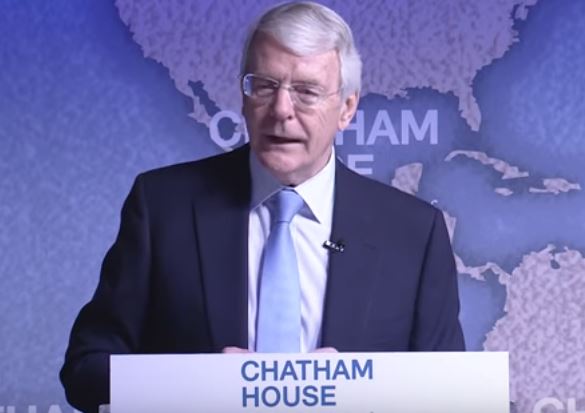
  • Sir John Major’s Chatham House Speech – 27 February 2017

    Below is the text of Sir John Major’s speech at Chatham House in London on 27 February 2017.


    BRITAIN AND EUROPE – A REALITY CHECK

    Eight months ago a majority of voters opted to leave the European Union. I believed then – as I do now – that was an historic mistake, but it was one – once asked – that the British nation had every right to make.

    The Government cannot ignore the nation’s decision and must now shape a new future for our country.

    Some changes may be beneficial: others may not. A hard Brexit – which is where we seem to be headed – is high risk. Some will gain. Others – will lose.

    Many outcomes will be very different from present expectations.  We will find, for example, that – for all the social pressure for immigration control – economically, we will need their skills.

    The Referendum was one of the most divisive votes in British history. It not only divided the four nations of our United Kingdom, but opened up divisions within those nations, within political parties, within neighbourhoods, within families, between age and income groups, and among friends.

    It will not be easy to heal those divisions and unite our nations. Yet that is what we must do.

    In Scotland, I believe a hard Brexit will encourage a second referendum on independence. This may seem improbable at the moment, but it would be reckless to ignore the risk.

    As we saw last June, emotion and national pride can overcome economic self-interest. If Scotland were to become independent, both she and the UK would be diminished. That cannot be ignored as Brexit evolves.

    The same is true of Northern Ireland. Many years of painstaking effort went into the Irish Peace Process which, even apart from Brexit, is at a fragile moment. Uncertainties over border restrictions between Ulster and the Republic are a serious threat – to the UK, to the peace process, and for Ireland, North and South. A special deal will be necessary.

    I will return to these issues on another occasion.

    As I voted on the losing side, I have kept silent since last June. This evening I don’t wish to argue the EU is perfect. Plainly it isn’t. Nor do I deny the economy has been more tranquil than expected since the decision to leave was taken.

    But I do observe we haven’t yet left the EU, and I have watched with growing concern as the British people have been led to expect a future that seems to be unreal and over-optimistic. Obstacles are brushed aside as of no consequence, whilst opportunities are inflated beyond any reasonable expectation of delivery.

    I am no longer in politics. I have absolutely no wish to re-enter it in any capacity. I don’t seek publicity – more often than not, I shy away from it.

    But I can’t ignore what I learned in Government. Nor can I forget the people who voted to leave Europe in the belief it might improve their lives. If events go badly, their expectations will not be met, and whole communities will be worse off. The particular fear I have is that those most likely to be hurt will be those least able to protect themselves.

    So, I have two objectives this evening: to offer a reality check on our national prospects; and to warn against an over-optimism that – if unachieved – will sow further distrust between politics and the public – at a time when trust needs to be re-built. It would be better to underplay than overplay expectations.

    The post-referendum debate has been deeply dispiriting.

    After decades of campaigning, the anti-Europeans won their battle to take Britain out of Europe. But, in the afterglow of victory, their cheerleaders have shown a disregard that amounts to contempt for the 48% who believed our future was more secure within the European Union.

    Remain voters are of all political persuasions, and of none. Over recent months, many have written to me in dismay –even despair.

    They are people from every walk of life who have every right to their view, every right to express it, and every right to have their opinion represented and tested in Parliament.

    This 48% care no less for our country than the 52% who voted to leave. They are every bit as patriotic. But they take a different view of Britain’s future role in the world, and are deeply worried for themselves, for their families, and for our country.

    They do not deserve to be told that, since the decision has been taken, they must keep quiet and toe the line. A popular triumph at the polls – even in a referendum – does not take away the right to disagree – nor the right to express that dissent.

    Freedom of speech is absolute in our country. It’s not “arrogant” or “brazen” or “elitist”, or remotely “delusional” to express concern about our future after Brexit. Nor, by doing so, is this group undermining the will of the people: they are the people. Shouting down their legitimate comment is against all our traditions of tolerance. It does nothing to inform and everything to demean – and it is time it stopped.

    Our Parliament exists to scrutinise the Executive. That is its job. So, it is depressing to see “Leave” enthusiasts in Parliament acting against their own principles. To win the Referendum, they asserted the sovereignty of our own Parliament: now, they speak and vote to deny that same Parliament any meaningful role in shaping, in overseeing, or in approving the outcome of our negotiations in Europe. Our Parliament is not a rubber stamp – and should not be treated as if it were.

    As a former Parliamentarian, I believe the negotiations to come are so crucial to our nation’s future that the Government would be wise to take frequent account of public opinion through Parliamentary debate.

    Of course, neither Parliament nor public can micro-manage the negotiations. We must trust Ministers to do so. And they must have flexibility.

    But Parliament must be free to debate and comment and advise. For it not to do so would be wrong in principle: it would also be unwise politically if – as it might – the will of the people evolves, and the reality of Brexit becomes unpopular.

    The hopes of those who favoured leaving the European Union are sky-high. We are told that countries “are queueing up to do trade deals with us”. That “our best days lie ahead”.

    It all sounds very enticing. And – for the sake of our country – I hope the optimists are proved right. But I’m not sure they will be. My own experience of international negotiations – and the national self-interest that accompanies them –makes me doubt the rosy confidence being offered to the British people.  

    Negotiations are all about “give” and “take”. We know what the Brexiteers wish to take: yet we hear nothing about what our country may have to give in return. If anyone genuinely believes that Europe will concede all we wish for –and exact no price for doing so – then they are extraordinarily naïve.

    As I consider the complexities that lie ahead, the words of Kipling come to mind:

    “I keep six honest serving men

    (They taught me all I knew);

    Their names are What and Why and When,

    And How and Where and Who.”

    It is the detail – the what and the why, the when and the how, and the where and the who – that is key. To avoid later recriminations, the British public needs to be made aware now of the hurdles ahead – and what different outcomes will mean for their future.

    Let me turn to the politics of exit.

    Leaving the European Union is not just about trade. It will have political consequences. For over forty years, British foreign policy has been based upon the twin pillars of our relations with the United States and the European Union. To be straddled between these two economic and political giants has served us well.

    Outside the European Union, we become far more dependent upon the United States and – for four and possibly eight years – upon a President less predictable, less reliable and less attuned to our free market and socially liberal instincts than any of his predecessors.

    As a boy, I was taught that America was our greatest ally and – throughout my life – I have seen her as so.

    But America’s size and power means we are, by far, the junior partner: mostly we follow – only rarely can we lead. Despite the romantic view of committed Atlanticists, the “special relationship” is not a union of equals. I wish it were: but it isn’t; America dwarfs the UK in economic and military power. That, sadly – is fact.

    Once we are out of the EU, our relationship with the United States will change. She needs a close ally inside the EU: once outside, that can no longer be us.

    That may not be the only change. If we disagree with American policy, we may weaken our ties. But if we support it slavishly, we become seen as an American echo – an invidious role for a nation that has broken free from Europe to become more independent.

    And – inevitably – there will be disagreements: the US wish to contain China and engage Russia; we wish to contain Russia and engage China.

    We seem likely to disagree also on refugees, free trade, the legality of Jewish settlements, and climate change. How many disagreements can there be before even the closest of ties begin to fray?

    Until now, the world has seen the UK as a leader within Europe. We are the second largest economy, with hopes of one day overtaking Germany. We are one of only two nations with significant nuclear and military power. We have the widest, and deepest, foreign policy reach of any European nation.

    In Europe, we have often set policy: the Single Market; enlargement to the East; restraints upon expenditure –together with a host of less prominent policies. Our role within Europe has magnified the power of our nation state: once we leave, that will no longer be so.

    The Prime Minister knows all this: her policy to maintain a good relationship with Europe is surely right. But, at some time, she will have to face down those who favour total disengagement – and who have never accepted our role within Europe.

    For some, a total divorce has been a decades-long ambition. I believe they are utterly wrong. And although – today –they may be allies of the Prime Minister, the risk is that – tomorrow – they may not.

    I am no dedicated Europhile. I said “No” to the Euro and “No” to Schengen on open borders. But I have never doubted the importance of co-operation with a successful Europe.

    And – in voting to leave – we have done the EU great harm.

    For the loss of the UK will weaken the EU – especially when set against the superpowers of America or China. For the first time, the EU is contracting not expanding. It is about to become smaller and less relevant. And, without the UK, it may change in character, becoming more protectionist and less of a pillar of free trade. Such a Europe would be damaging to British interests.

    Our departure is also adding to domestic political problems across Europe. Britain has rejected the colossus of the EU. This has energised the anti-EU, anti-immigrant nationalists that are growing in number in France, Germany, Holland – and other European countries.

    None of these populist groups is sympathetic to the broadly tolerant and liberal instincts of the British. Nonetheless, their pitch is straightforward. If Britain – sober, stable, moderate, reliable Britain, with its ancient Parliament and anti-revolutionary history – can break free of a repressive bureaucracy in Brussels, why, then “so can anyone”. It is a potent appeal.

    I caution everyone to be wary of this kind of populism. It seems to be a mixture of bigotry, prejudice and intolerance. It scapegoats minorities. It is a poison in any political system – destroying civility and decency and understanding. Here in the UK we should give it short shrift, for it is not the people we are – nor the country we are.

    Whatever grievances exist, the UK and Europe cannot ignore one another without mutual damage. As the Prime Minister has intimated, our future self-interest is to co operate on all aspects of security; on terrorism; on crime.

    We should take a common position on climate change; on human rights; and on representative democracy. We should continue to co-operate over the migrant surge to Europe and contain Russian misbehaviour.

    The plain truth is this: irrespective of Brexit, the UK benefits from engagement with Europe – not isolation from Europe – and both parties have an interest in ensuring that is maintained.

    My hunch is that, over the years ahead, the political price of leaving the EU may turn out to be greater than the economic cost.

    That said – to protect our interests – the trade negotiations will require statesmanship of a high order. There is a real risk the outcome will fall well below the hopes and expectations that have been raised: I see little chance we will be able to match the advantages of the Single Market.

    In my own experience, the most successful results are obtained when talks are conducted with goodwill: it is much easier to reach agreement with a friend than a quarrelsome neighbour.

    But, behind the diplomatic civilities, the atmosphere is already sour. A little more charm, and a lot less cheap rhetoric, would do much to protect the UK’s interests.

    The negotiations will begin with the costs of disengagement. These could be politically explosive.

    During the Referendum, the “Leave” campaign promised to “take back control” of huge sums of money, and pay an additional £350 million a week to the NHS.

    Many believed this, yet the bitter irony is that the “divorce settlement” – that is, the cost of leaving Europe – may involve paying out much larger sums of money than that.

    The EU Chief Negotiator has estimated that our bill for exit may total between €40 billion to €60 billion.

    I find this figure very contentious. But the bill will be substantial: billions, not millions, and very unpalatable. It will come as a nasty shock to voters who were not forewarned of this – even in the recent White Paper.

    One MP has referred to the estimated divorce payment as “a threat”, his argument being that “you pay to join a club but not to leave it”.

    Of course that is true: but when you leave any club, you are obliged to settle your debts, and that is what the European Union is going to expect the UK to do.

    There are liabilities to be met: pension costs, legacy costs, contingent liabilities, a proportional share of work-in-progress. The EU will argue we have a legal obligation to pay these bills.

    They may be right – but the issue is not clear-cut. Some of the EU’s claims are highly questionable and – unless there is a political agreement – any dispute may have to be resolved in Court. An agreement would be preferable and, if she sanctions one, the Prime Minister will deserve support.

    The EU Chief Negotiator has also warned that the separation costs must be agreed before any detailed trade negotiations can begin. However, I doubt he will be able to sustain such a hard line if we are prepared to engage in constructive talks: we shall see.

    But if there is a stand-off – perhaps because of a backlash against the size of the exit bill – then trade talks may have to await a Court decision, be delayed indefinitely – or scrapped altogether. In either event, the faint hope of a comprehensive trade deal by Spring 2019 will have gone.

    Without such a deal with Europe, three options arise:

      – we can leave the EU with a flimsy, inadequate deal; or

      – we can seek a transitional relationship – perhaps for 3-5 years – for which, as non-members, we would have to pay. A minimum option would involve staying in the Customs Union and submitting to the jurisdiction of the European Court of Justice; or

      – we can trade with the EU on a WTO basis.

    The more one examines probabilities, the more contentious becomes the task of leaving.

    Some of the most committed Brexit supporters wish to have a clean break, and trade only under WTO rules. This would require tariffs on goods – with nothing to help services, and nothing to inhibit non-tariff barriers. This would not be a panacea; for the UK – it would be the worst possible outcome.

    But – to those who wish to see us adapt to a deregulated, low-tax enterprise economy – it is an attractive option, and wholly consistent with their philosophy.

    However, it has worrying implications for public services such as the NHS – and for the vulnerable who, I’m delighted to say, the Government has pledged to help …. and I know how personally committed the Prime Minister is to this.

    So there is a choice to be made, a price to be paid; we cannot move to a radical enterprise economy without moving away from a welfare state. Such a direction of policy, once understood by the public, would never command support. It would make all previous rows over social policy seem a minor distraction.

    A new trade deal with Europe will be hugely complex. No-one should envy the Secretary of State and his negotiators. Some industries – cars and aerospace for example – hope for special, perhaps industry-to-industry, deals for their exports to Europe. The difficulties of this are legion: the chances of success are slim – not least since the German Chancellor is likely to rule out sectoral deals. Even if she does not, WTO rules expect agreements to cover all trade, not a few handpicked sectors.

    Many practicalities arise: even a partial customs deal with Europe would not eliminate the need for country-of-origin certificates. Or border checks. Or certification that regulations are met. Or other frustrations. And any deal must be agreed by 27 nations, each with their own national interests. No-one can be certain how long this will take: a conclusion within two years is very, very optimistic. Business needs to factor this in to their plans.

    Domestic political hurdles arise, too: if cars and aerospace were to get favourable deals, why not textiles and widgets? How would the Government soothe the ire of those not receiving preferential treatment?

    Nor will free trade deals with third countries be straightforward. Even the most attractive options come with political hazards.

    In Washington, the Prime Minister discussed a deal with President Trump. Both Leaders were keen, which is excellent. But the omens are mixed.

    Early actions confirm that President Trump has put protectionism at the heart of his trade policy. “America First” is more than a slogan.

    Tariffs between the US and the UK are already minimal: there is little scope for lowering them even further. The UK runs a healthy trade surplus with America: President Trump may wish to narrow – or eliminate – that gap. That being so, British hopes should not be set too high.

    Nor will it be easy – or quick – to reach agreement on contentious issues such as medicine, or cars, or beef raised with growth hormones. In comes American beef: Out go European subsidies. That won’t be an easy sell to the beef industry.  

    China and India are both attractive candidates for enhanced trade. But, in negotiation, India will seek immigration concessions for students and non-students alike which, prima facie, is in direct conflict with Government plans.

    China, as I know from experience, is a tough negotiator, and will strike a hard bargain. As she is the largest trading partner to 120 countries, and the largest export market for 70 of them, a trade agreement with the United Kingdom may not be one of her main priorities.

    The Government must also replicate the 53 deals struck on our behalf by the European Union. So far, only 12 are in play. There is a very, very long way to go, and the question arises: are 65 million Britons likely to get the same favourable outcome as 500 million Europeans?

    I set out these difficulties, not because I don’t think deals can be done – some certainly can – but to be realistic about the timescale and complexity of the huge undertaking that lies ahead. It is crucial to business and the public – that our expectations are consistent with what can be delivered. It matters to the Government, too: Ministers must not over-promise.

    In two years’ time, the UK will be the first nation to leave the EU. This will be a real irony, as the first proposal for a European Union came not – as is generally supposed – from the Frenchman, Jean Monnet, but from an Englishman.

    Three and a quarter centuries ago, in 1693, William Penn advocated a European “Dyet or Parliament” as a policy to end perpetual military conflict on the Continent. It took 280 years and two world wars to convince his fellow Britons.

    43 years later, the British people reversed that decision.

    Let us hope – for the futures of our children and grandchildren – they were right.