Category: 2015-

  • Sir John Major’s Foreign Office Speech – 4 July 2017

    Below is the text of Sir John Major’s speech at the Foreign Office following the publication of a history note on homosexuality. The speech was made in the Locarno Room on 4 July 2017.


    When Stephen Wall invited me to join you today, I was happy to accept. Twenty five years ago, he was a valued advisor: today, he remains a valued friend.

    A few decades ago, publication of the “History Note” we celebrate today would have been inconceivable: any meeting advocating such a change would have been held in private, behind locked doors, with participants perhaps fearful their careers would be ended – and their lives ruined – if their sexual preferences were known.

    That fear was based on the belief that exposure would have led to public condemnation and, for those in sensitive posts, the risk of blackmail.

    But those fears were only true – could only be true – if public attitude was hostile. Once the light was let in; once it became widely accepted that – throughout history – many great men and women had been gay; once courageous gay pioneers went public, bigotry began to dissolve. Tolerance – an altogether more enlightened attitude – took over, and the atmosphere began to change. Many senior public servants, including Patrick Wright, then PUS – knew this was both necessary and inevitable.

    At this moment, our country is in a sour, uncertain mood: divided over Brexit; over the Union; over globalisation; over the distribution of wealth and the extent of poverty; and much else …. In the whole of my political life I cannot recall such an unsettled time. That said – with wisdom and commonsense – I am confident we will overcome the current difficulties.

    I am reinforced in that view by the extent our present miseries remind us how much – during my own lifetime – some attitudes have changed for the better.

    In the 1950s, much public opinion was anti-Black and anti-gay. No-one would have ever imagined that so many black and gay people would become the icons of today.  

    Nor would the concept of women holding some of the highest positions in the land have seemed remotely possible. But, in recent years, we have had not just one but two female Prime Ministers; two Director Generals of MI5; three Home Secretaries and – here in London – we now have a female Police Commissioner and Head of the London Fire Brigade. We also have women representing one in every three Parliamentary constituencies.

    Not long ago, all of this would have been beyond parody. And yet it is today’s reality. In many spheres there is, of course, more to be done. But the progress we have made during the last few decades dwarfs that of past centuries.

    In fashioning the public mood, we need to acknowledge successes as well as challenges.

    Bigotry hasn’t gone: witness the shameful hostility that was whipped up during the Brexit campaign – raising irrational fears about the effect of immigration. But, overall, such sentiments are generally in retreat and out of time.

    Some argue that our nation has become too liberal, too permissive, too prepared to junk all standards – and many here may sympathise with that. Certainly, on occasion, I do.

    But – and it is a big but – I would far rather have an excess of liberalism than of bigotry and so, I believe, would most others. Liberal tolerance must surely be an attractive trait – provided we do not abuse it by defending the indefensible.

    As we look back down the years we can see that high achievement and service to our nation is not restricted to those with conventional lifestyles. Many gay men and women have shaped our history, our literature and our social attitudes.

    Consider Alan Turing, without whom the enigma code might never have been broken; many more lives might have been lost; and the Second World War might not have been won. And yet – despite his extraordinary service to our nation – he was treated abominably. That would never happen today – and I rejoice in that.

    I was fortunate enough to be in a position to end the discrimination against gay members of the Civil Service. My only regret was that this liberation was so long delayed.

    Throughout my time in Government I was aware that those in public service who were gay forged their way towards the top through hard work and ability yet – despite those attributes – most stopped short of the very top jobs. Once again, thankfully, that is no longer so.

    I recall a very senior Civil Servant suggesting to me that one very able candidate put forward to join my Private Office might – as he put it – “attract attention” because of his lifestyle. My only thought about that proposition was that it was wrong.

    I would never have denied a politician a Ministerial job on the grounds that he or she would “attract attention”, and there was no logic (or fairness) in treating civil servants any less well.

    So that candidate did join my office – on merit – and was a real asset to it: nor did he ever attract any unwanted attention either from within – or beyond – the Civil Service.

    Subsequently, no such concern was ever put to me again and I continued to enjoy working with officials of differing personal lifestyles.

    Nonetheless, in a very small way, I experienced the hostility that many others had to endure on a more regular basis. When I decided to compensate haemophiliacs infected with HIV as a result of contaminated blood transfusions, the correspondence I received was truly vile.

    And when I wished to consult Ian McKellen on the concerns of gay people, there were subterranean rumblings that I should never even have spoken to him – let alone invited him into No 10!

    It was absurd. Here was one of our greatest actors, and a powerful advocate for a cause affecting the lives and freedom of action of many British people – and some thought the Prime Minister should not even meet him. Such an attitude was simply astonishing. Personally, I never regretted that meeting – and learned a great deal from it.

    By sheer coincidence, later that same day, I met Edith Cresson, the then Prime Minister of France, who famously remarked – and I quote verbatim – that “half of Anglo-Saxon men are homosexual”. Observing diplomatic niceties, I refrained from asking how she had gone about her research for this particular statement ….

    Two years later, with my encouragement, Parliament voted to lower the age of consent to eighteen – not quite the sixteen that the now Sir Ian McKellen had advocated, but a lowering nonetheless.

    As we look back I am glad of this wider tolerance. The rigid prejudice of the past caused many people, who harmed no-one, to live in fear and isolation. No- one should be forced to live their lives in this fashion due to their personal life choices.

    We are what we are. We are what fate made us. And, whatever that may be, we are entitled to give and receive affection. A life without affection is a life lacking an essential ingredient for happiness. I am proud that, overwhelmingly, most people today – and especially the young – have moved on from the social prejudices of earlier generations.

    If people do not go out of their way to frighten the horses, or gratuitously shock their neighbours, then their lifestyle should be for them to choose without condemnation or stigma.

    I am happy to say that – to a greater extent than ever before – that is where we are now.  

    To me, that certainly merits a celebration, and I wish you all a stimulating discussion to come, and an enjoyable afternoon.

  • Sir John Major’s Chatham House Speech – 27 February 2017

    Below is the text of Sir John Major’s speech at Chatham House in London on 27 February 2017.
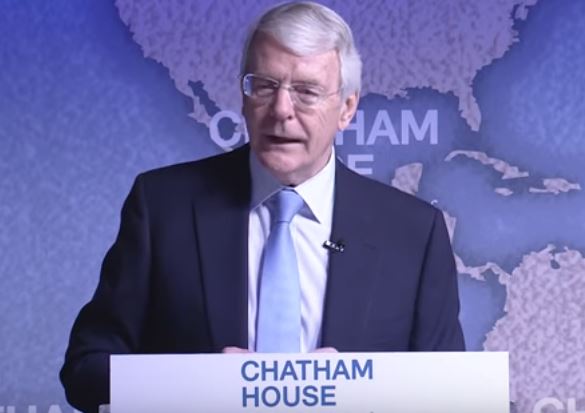

    BRITAIN AND EUROPE – A REALITY CHECK

    Eight months ago a majority of voters opted to leave the European Union. I believed then – as I do now – that was an historic mistake, but it was one – once asked – that the British nation had every right to make.

    The Government cannot ignore the nation’s decision and must now shape a new future for our country.

    Some changes may be beneficial: others may not. A hard Brexit – which is where we seem to be headed – is high risk. Some will gain. Others – will lose.

    Many outcomes will be very different from present expectations.  We will find, for example, that – for all the social pressure for immigration control – economically, we will need their skills.

    The Referendum was one of the most divisive votes in British history. It not only divided the four nations of our United Kingdom, but opened up divisions within those nations, within political parties, within neighbourhoods, within families, between age and income groups, and among friends.

    It will not be easy to heal those divisions and unite our nations. Yet that is what we must do.

    In Scotland, I believe a hard Brexit will encourage a second referendum on independence. This may seem improbable at the moment, but it would be reckless to ignore the risk.

    As we saw last June, emotion and national pride can overcome economic self-interest. If Scotland were to become independent, both she and the UK would be diminished. That cannot be ignored as Brexit evolves.

    The same is true of Northern Ireland. Many years of painstaking effort went into the Irish Peace Process which, even apart from Brexit, is at a fragile moment. Uncertainties over border restrictions between Ulster and the Republic are a serious threat – to the UK, to the peace process, and for Ireland, North and South. A special deal will be necessary.

    I will return to these issues on another occasion.

    As I voted on the losing side, I have kept silent since last June. This evening I don’t wish to argue the EU is perfect. Plainly it isn’t. Nor do I deny the economy has been more tranquil than expected since the decision to leave was taken.

    But I do observe we haven’t yet left the EU, and I have watched with growing concern as the British people have been led to expect a future that seems to be unreal and over-optimistic. Obstacles are brushed aside as of no consequence, whilst opportunities are inflated beyond any reasonable expectation of delivery.

    I am no longer in politics. I have absolutely no wish to re-enter it in any capacity. I don’t seek publicity – more often than not, I shy away from it.

    But I can’t ignore what I learned in Government. Nor can I forget the people who voted to leave Europe in the belief it might improve their lives. If events go badly, their expectations will not be met, and whole communities will be worse off. The particular fear I have is that those most likely to be hurt will be those least able to protect themselves.

    So, I have two objectives this evening: to offer a reality check on our national prospects; and to warn against an over-optimism that – if unachieved – will sow further distrust between politics and the public – at a time when trust needs to be re-built. It would be better to underplay than overplay expectations.

    The post-referendum debate has been deeply dispiriting.

    After decades of campaigning, the anti-Europeans won their battle to take Britain out of Europe. But, in the afterglow of victory, their cheerleaders have shown a disregard that amounts to contempt for the 48% who believed our future was more secure within the European Union.

    Remain voters are of all political persuasions, and of none. Over recent months, many have written to me in dismay –even despair.

    They are people from every walk of life who have every right to their view, every right to express it, and every right to have their opinion represented and tested in Parliament.

    This 48% care no less for our country than the 52% who voted to leave. They are every bit as patriotic. But they take a different view of Britain’s future role in the world, and are deeply worried for themselves, for their families, and for our country.

    They do not deserve to be told that, since the decision has been taken, they must keep quiet and toe the line. A popular triumph at the polls – even in a referendum – does not take away the right to disagree – nor the right to express that dissent.

    Freedom of speech is absolute in our country. It’s not “arrogant” or “brazen” or “elitist”, or remotely “delusional” to express concern about our future after Brexit. Nor, by doing so, is this group undermining the will of the people: they are the people. Shouting down their legitimate comment is against all our traditions of tolerance. It does nothing to inform and everything to demean – and it is time it stopped.

    Our Parliament exists to scrutinise the Executive. That is its job. So, it is depressing to see “Leave” enthusiasts in Parliament acting against their own principles. To win the Referendum, they asserted the sovereignty of our own Parliament: now, they speak and vote to deny that same Parliament any meaningful role in shaping, in overseeing, or in approving the outcome of our negotiations in Europe. Our Parliament is not a rubber stamp – and should not be treated as if it were.

    As a former Parliamentarian, I believe the negotiations to come are so crucial to our nation’s future that the Government would be wise to take frequent account of public opinion through Parliamentary debate.

    Of course, neither Parliament nor public can micro-manage the negotiations. We must trust Ministers to do so. And they must have flexibility.

    But Parliament must be free to debate and comment and advise. For it not to do so would be wrong in principle: it would also be unwise politically if – as it might – the will of the people evolves, and the reality of Brexit becomes unpopular.

    The hopes of those who favoured leaving the European Union are sky-high. We are told that countries “are queueing up to do trade deals with us”. That “our best days lie ahead”.

    It all sounds very enticing. And – for the sake of our country – I hope the optimists are proved right. But I’m not sure they will be. My own experience of international negotiations – and the national self-interest that accompanies them –makes me doubt the rosy confidence being offered to the British people.  

    Negotiations are all about “give” and “take”. We know what the Brexiteers wish to take: yet we hear nothing about what our country may have to give in return. If anyone genuinely believes that Europe will concede all we wish for –and exact no price for doing so – then they are extraordinarily naïve.

    As I consider the complexities that lie ahead, the words of Kipling come to mind:

    “I keep six honest serving men

    (They taught me all I knew);

    Their names are What and Why and When,

    And How and Where and Who.”

    It is the detail – the what and the why, the when and the how, and the where and the who – that is key. To avoid later recriminations, the British public needs to be made aware now of the hurdles ahead – and what different outcomes will mean for their future.

    Let me turn to the politics of exit.

    Leaving the European Union is not just about trade. It will have political consequences. For over forty years, British foreign policy has been based upon the twin pillars of our relations with the United States and the European Union. To be straddled between these two economic and political giants has served us well.

    Outside the European Union, we become far more dependent upon the United States and – for four and possibly eight years – upon a President less predictable, less reliable and less attuned to our free market and socially liberal instincts than any of his predecessors.

    As a boy, I was taught that America was our greatest ally and – throughout my life – I have seen her as so.

    But America’s size and power means we are, by far, the junior partner: mostly we follow – only rarely can we lead. Despite the romantic view of committed Atlanticists, the “special relationship” is not a union of equals. I wish it were: but it isn’t; America dwarfs the UK in economic and military power. That, sadly – is fact.

    Once we are out of the EU, our relationship with the United States will change. She needs a close ally inside the EU: once outside, that can no longer be us.

    That may not be the only change. If we disagree with American policy, we may weaken our ties. But if we support it slavishly, we become seen as an American echo – an invidious role for a nation that has broken free from Europe to become more independent.

    And – inevitably – there will be disagreements: the US wish to contain China and engage Russia; we wish to contain Russia and engage China.

    We seem likely to disagree also on refugees, free trade, the legality of Jewish settlements, and climate change. How many disagreements can there be before even the closest of ties begin to fray?

    Until now, the world has seen the UK as a leader within Europe. We are the second largest economy, with hopes of one day overtaking Germany. We are one of only two nations with significant nuclear and military power. We have the widest, and deepest, foreign policy reach of any European nation.

    In Europe, we have often set policy: the Single Market; enlargement to the East; restraints upon expenditure –together with a host of less prominent policies. Our role within Europe has magnified the power of our nation state: once we leave, that will no longer be so.

    The Prime Minister knows all this: her policy to maintain a good relationship with Europe is surely right. But, at some time, she will have to face down those who favour total disengagement – and who have never accepted our role within Europe.

    For some, a total divorce has been a decades-long ambition. I believe they are utterly wrong. And although – today –they may be allies of the Prime Minister, the risk is that – tomorrow – they may not.

    I am no dedicated Europhile. I said “No” to the Euro and “No” to Schengen on open borders. But I have never doubted the importance of co-operation with a successful Europe.

    And – in voting to leave – we have done the EU great harm.

    For the loss of the UK will weaken the EU – especially when set against the superpowers of America or China. For the first time, the EU is contracting not expanding. It is about to become smaller and less relevant. And, without the UK, it may change in character, becoming more protectionist and less of a pillar of free trade. Such a Europe would be damaging to British interests.

    Our departure is also adding to domestic political problems across Europe. Britain has rejected the colossus of the EU. This has energised the anti-EU, anti-immigrant nationalists that are growing in number in France, Germany, Holland – and other European countries.

    None of these populist groups is sympathetic to the broadly tolerant and liberal instincts of the British. Nonetheless, their pitch is straightforward. If Britain – sober, stable, moderate, reliable Britain, with its ancient Parliament and anti-revolutionary history – can break free of a repressive bureaucracy in Brussels, why, then “so can anyone”. It is a potent appeal.

    I caution everyone to be wary of this kind of populism. It seems to be a mixture of bigotry, prejudice and intolerance. It scapegoats minorities. It is a poison in any political system – destroying civility and decency and understanding. Here in the UK we should give it short shrift, for it is not the people we are – nor the country we are.

    Whatever grievances exist, the UK and Europe cannot ignore one another without mutual damage. As the Prime Minister has intimated, our future self-interest is to co operate on all aspects of security; on terrorism; on crime.

    We should take a common position on climate change; on human rights; and on representative democracy. We should continue to co-operate over the migrant surge to Europe and contain Russian misbehaviour.

    The plain truth is this: irrespective of Brexit, the UK benefits from engagement with Europe – not isolation from Europe – and both parties have an interest in ensuring that is maintained.

    My hunch is that, over the years ahead, the political price of leaving the EU may turn out to be greater than the economic cost.

    That said – to protect our interests – the trade negotiations will require statesmanship of a high order. There is a real risk the outcome will fall well below the hopes and expectations that have been raised: I see little chance we will be able to match the advantages of the Single Market.

    In my own experience, the most successful results are obtained when talks are conducted with goodwill: it is much easier to reach agreement with a friend than a quarrelsome neighbour.

    But, behind the diplomatic civilities, the atmosphere is already sour. A little more charm, and a lot less cheap rhetoric, would do much to protect the UK’s interests.

    The negotiations will begin with the costs of disengagement. These could be politically explosive.

    During the Referendum, the “Leave” campaign promised to “take back control” of huge sums of money, and pay an additional £350 million a week to the NHS.

    Many believed this, yet the bitter irony is that the “divorce settlement” – that is, the cost of leaving Europe – may involve paying out much larger sums of money than that.

    The EU Chief Negotiator has estimated that our bill for exit may total between €40 billion to €60 billion.

    I find this figure very contentious. But the bill will be substantial: billions, not millions, and very unpalatable. It will come as a nasty shock to voters who were not forewarned of this – even in the recent White Paper.

    One MP has referred to the estimated divorce payment as “a threat”, his argument being that “you pay to join a club but not to leave it”.

    Of course that is true: but when you leave any club, you are obliged to settle your debts, and that is what the European Union is going to expect the UK to do.

    There are liabilities to be met: pension costs, legacy costs, contingent liabilities, a proportional share of work-in-progress. The EU will argue we have a legal obligation to pay these bills.

    They may be right – but the issue is not clear-cut. Some of the EU’s claims are highly questionable and – unless there is a political agreement – any dispute may have to be resolved in Court. An agreement would be preferable and, if she sanctions one, the Prime Minister will deserve support.

    The EU Chief Negotiator has also warned that the separation costs must be agreed before any detailed trade negotiations can begin. However, I doubt he will be able to sustain such a hard line if we are prepared to engage in constructive talks: we shall see.

    But if there is a stand-off – perhaps because of a backlash against the size of the exit bill – then trade talks may have to await a Court decision, be delayed indefinitely – or scrapped altogether. In either event, the faint hope of a comprehensive trade deal by Spring 2019 will have gone.

    Without such a deal with Europe, three options arise:

      – we can leave the EU with a flimsy, inadequate deal; or

      – we can seek a transitional relationship – perhaps for 3-5 years – for which, as non-members, we would have to pay. A minimum option would involve staying in the Customs Union and submitting to the jurisdiction of the European Court of Justice; or

      – we can trade with the EU on a WTO basis.

    The more one examines probabilities, the more contentious becomes the task of leaving.

    Some of the most committed Brexit supporters wish to have a clean break, and trade only under WTO rules. This would require tariffs on goods – with nothing to help services, and nothing to inhibit non-tariff barriers. This would not be a panacea; for the UK – it would be the worst possible outcome.

    But – to those who wish to see us adapt to a deregulated, low-tax enterprise economy – it is an attractive option, and wholly consistent with their philosophy.

    However, it has worrying implications for public services such as the NHS – and for the vulnerable who, I’m delighted to say, the Government has pledged to help …. and I know how personally committed the Prime Minister is to this.

    So there is a choice to be made, a price to be paid; we cannot move to a radical enterprise economy without moving away from a welfare state. Such a direction of policy, once understood by the public, would never command support. It would make all previous rows over social policy seem a minor distraction.

    A new trade deal with Europe will be hugely complex. No-one should envy the Secretary of State and his negotiators. Some industries – cars and aerospace for example – hope for special, perhaps industry-to-industry, deals for their exports to Europe. The difficulties of this are legion: the chances of success are slim – not least since the German Chancellor is likely to rule out sectoral deals. Even if she does not, WTO rules expect agreements to cover all trade, not a few handpicked sectors.

    Many practicalities arise: even a partial customs deal with Europe would not eliminate the need for country-of-origin certificates. Or border checks. Or certification that regulations are met. Or other frustrations. And any deal must be agreed by 27 nations, each with their own national interests. No-one can be certain how long this will take: a conclusion within two years is very, very optimistic. Business needs to factor this in to their plans.

    Domestic political hurdles arise, too: if cars and aerospace were to get favourable deals, why not textiles and widgets? How would the Government soothe the ire of those not receiving preferential treatment?

    Nor will free trade deals with third countries be straightforward. Even the most attractive options come with political hazards.

    In Washington, the Prime Minister discussed a deal with President Trump. Both Leaders were keen, which is excellent. But the omens are mixed.

    Early actions confirm that President Trump has put protectionism at the heart of his trade policy. “America First” is more than a slogan.

    Tariffs between the US and the UK are already minimal: there is little scope for lowering them even further. The UK runs a healthy trade surplus with America: President Trump may wish to narrow – or eliminate – that gap. That being so, British hopes should not be set too high.

    Nor will it be easy – or quick – to reach agreement on contentious issues such as medicine, or cars, or beef raised with growth hormones. In comes American beef: Out go European subsidies. That won’t be an easy sell to the beef industry.  

    China and India are both attractive candidates for enhanced trade. But, in negotiation, India will seek immigration concessions for students and non-students alike which, prima facie, is in direct conflict with Government plans.

    China, as I know from experience, is a tough negotiator, and will strike a hard bargain. As she is the largest trading partner to 120 countries, and the largest export market for 70 of them, a trade agreement with the United Kingdom may not be one of her main priorities.

    The Government must also replicate the 53 deals struck on our behalf by the European Union. So far, only 12 are in play. There is a very, very long way to go, and the question arises: are 65 million Britons likely to get the same favourable outcome as 500 million Europeans?

    I set out these difficulties, not because I don’t think deals can be done – some certainly can – but to be realistic about the timescale and complexity of the huge undertaking that lies ahead. It is crucial to business and the public – that our expectations are consistent with what can be delivered. It matters to the Government, too: Ministers must not over-promise.

    In two years’ time, the UK will be the first nation to leave the EU. This will be a real irony, as the first proposal for a European Union came not – as is generally supposed – from the Frenchman, Jean Monnet, but from an Englishman.

    Three and a quarter centuries ago, in 1693, William Penn advocated a European “Dyet or Parliament” as a policy to end perpetual military conflict on the Continent. It took 280 years and two world wars to convince his fellow Britons.

    43 years later, the British people reversed that decision.

    Let us hope – for the futures of our children and grandchildren – they were right.

  • Sir John Major’s Speech at Consortium for Street Children – 15 November 2016

    Below is the text of Sir John Major’s speech at Consortium for Street Children on Tuesday 15 November 2016.


    SIR JOHN MAJOR:

    It is hard to believe it is nearly a quarter of a century since I spoke at the launch of the Consortium. Today, it is a global network to protect children, and its growth and success is largely due to the dedication of many of the pioneers who are here this evening. They have taken us a long way.

    It is easy to see why they are so committed, and why I wished to be a part of their work 23 years ago. All children deserve care – not just some of them. They deserve a home, a family, security, education, adult guidance and – above all – love and affection. And yet – although we cannot be precise as to numbers – it is likely that, in 2016, 150 million children enjoy none of these benefits. They face the world alone, and can be found on every Continent. In every way, this is unacceptable.

    When children are not cared for – we have all let them down. By we – I mean governments and individuals. It is – to me – extraordinary that they have been left so far behind for so long. Extraordinary – and indefensible. It is as if they are invisible to the conscience of the world.

    Now – at last – we may be on the eve of a breakthrough that is long overdue. Next Spring, the United Nations will issue a General Comment – an unimaginative name for a vital advance. A General Comment is a legal framework that will offer guidance, and set out governments’ obligations to children and how our responsibilities to them should be met. This will provide – for the first time – an opportunity for civil society to hold policy-makers to account if they don’t take action: and for street children it could – and should – be Liberation Day.

    But, of course, the effect of this won’t be instant – for the children or anyone else. The scale of the task is immense, and what needs to be done will take a very long time. But, once begun – and with continued advocacy – it should develop its own momentum.

    On behalf of those street children everywhere who don’t know – and may never know – who their advocates have been, a heartfelt thank you to all those here this evening who have done so much to bring this about.

    However, important though this advance is, it’s not enough. Declarations don’t house the homeless or feed the hungry. But it most definitely marks the beginning of what we hope will bring about the end of this truly terrible – and unacceptable – human neglect.

    So we all need to make sure the General Comment is implemented fully. I say this because we have all seen how grudging the international response has been for refugee children – despite the horrors of Syria. This should make us realise that, although we may cheer this advance, we cannot yet celebrate a victory.

    Over 23 years, and across 130 countries, hundreds of thousands of deprived children have been helped. But we have so much more to do. Sometimes their enemy is not disinterest – but the lack of Government action or the wrong action.

    As a child in Harare told us about the police: “They treat us as animals, they can raid us and lock us up in a cell for three weeks and they would only give us dry bread for food.”

    The General Comment can be used by Governments to eliminate police round-ups of children who are loitering, or sleeping in public places.

    And, from a Mexican child: “There are street children who die, while others survive, because they don’t have the money to pay for a hospital.”

    The General Comment spells out to governments their obligations to end discrimination so that, for example, specialised health services and education are made available – free of charge – to street children.

    I could go on.

    In the past, UN action has sometimes been ignored. We must make sure this one is not. These neglected children are in dire need and, having put so much effort into getting this far, we must understand that there is still so much more to be done.

    Uruguay has – or is about to – announce that she will be an “Early Adopter” of the General Comment – which is tremendous news, but we must plead with/encourage/persuade others to do the same.

    So we still need pledges – of help, of expertise, of cash – to increase the momentum of our campaign. As a wise man once said – “Money is the root of all progress”: and that is certainly true of our own work.

    To those of you who already feel overwhelmed by all your other responsibilities, I would only say this: Many – most – of us present have children – or, in my own case, children and grandchildren. How would we feel if any one of them was condemned to live the life of a street child? Cold; hungry; and certainly alone; with no-one to turn to, and no-one to rely on. Even worse, without the most basic human need of all: hope.

    Would we not think we had failed? Yes, we would.

    So, in a sense, we are all parents of these lost children. And when we think of it in that way, we know we must help.

    So, thank you for what you have done, are doing, and will be doing to help those who cannot help themselves.

    Let me close with the following thought:

    When you go home this evening, you – like millions of others around the world – will walk into a warm and welcoming place. You may pour yourself a glass of wine … or two. You may look inside a well-stocked fridge for a snack. You may pop something into the oven. Or flip on the kettle to make a hot drink. You will then climb into a soft and comfortable bed; warm, well-fed and – above all – safe and secure behind a locked door.

    As I say, like millions of others. But with one key difference: as you turn the lights out you will be the ones who – by being here tonight – have helped some of the youngest and most vulnerable people in our world clamber out of despair to – hopefully – experience the same degree of comfort and security.

    And that, I hope, will lead to a very peaceful night’s sleep indeed.

    Thank you for being here, and joining our crusade for fairness to children: it is a cause to warm the conscience.

  • Sir John Major’s Tribute to Shimon Peres – 28 September 2016

    Below is the text of Sir John Major’s tribute to Shimon Peres, issued on 28 September 2016.


    SIR JOHN MAJOR:

    Shimon Peres was a giant of Israeli politics. He tried consistently to broker a peace between Israel and the Palestinians. He took the long view that Israel needed security with their near neighbours to protect them from wider dangers. He was a true patriot, and Israel has lost one of its most illustrious leaders.

  • Sir John Major’s Comments in Bristol on EU Referendum – 22 June 2016

    Below are extracts of the speech made by Sir John Major in Bristol on 22 June 2016.


    SIR JOHN MAJOR:

    This is the last day we have left to try and persuade the British people to remain in the EU.

    As Prime Minister, European rows upset many of my ambitions. I should wish to leave …. and yet I passionately believe that our jobs, homes, savings and family life will be safer and more secure if we remain in the EU.

    Of course I understand there is concern over the current level of immigration – I stress current. I understand it – the PM understands it. But leaving the EU is no solution. To try and solve a short-term problem by doing so is to risk a far greater longer-term impact on our prosperity and place in the world.

    If we were to leave, we would be seriously diminished as a country. I don’t want a Broken Britain without influence. And that is what we risk.

    Throughout this campaign I – and others – have been accused of “scaremongering”. Of running a “Project Fear”. What a grotesque travesty of the truth.

    So many respected bodies have pointed out the risks – and the Remain campaign has a duty to inform, correct myths and untruths – and to warn. That is Project Reality.

    That is our responsibility. If we had failed in that – and if the British people vote out and all the things we have warned of come to pass – they would be fully entitled to say: “Why on earth did no-one ever tell us it would be like this?”

    The British people will make their own choice tomorrow – but I do not want to sit on my rocking chair in a few years’ time wishing I had done more to lay the truth on the line …

    Of course being a member of the EU can be frustrating. Sometimes deeply frustrating. No-one knows that better than me – and the PM – for both of us have sat around that top table for many years.

    But the benefits of being inside the EU are real and by far outweigh any downsides: our international prestige, influence, security, wellbeing are all enhanced inside Europe.

    As I stand here beside a still very youthful and energetic PM … I am very much aware that I represent the “grey” vote – actually, I think I’ve probably represented that for many years …..

    But this is an important point: many people my own age – and older – remember the last referendum in 1975. Many say “We voted IN then – but we never voted for this ….. we never voted for what we have now ….. this is my chance to reverse that … to get out of Europe”.

    I understand that sentiment, but would put another one to them: our country, Europe – and the wider world – is a very different place than it was in 1975. The world has moved on – and we have had to move with it. Who would have imagined that China would become so economically dominant? Who would have imagined that the communist Soviet Union would collapse, and that wall of division – of hate – between the East and the West would be torn down? Who would have foreseen the Global Market?

    Our country is as free as any in the world. We take freedom for granted. Political freedom. Freedom of movement. And these are not one-way freedoms: our children and grandchildren think nothing of hopping onto Eurostar and heading off to Paris for a weekend break. Or travelling around Europe with a backpack earning money to pay their way …. why should such freedoms be denied to others?

    Our nation is instinctively compassionate, open-hearted, generous-spirited, fair-minded and tolerant. We balk against hatred and extremism. We are fiercely patriotic – but not nationalistic.

    And it is patriotic to work with others to ensure our security; to improve our economic well-being; to carry British influence and British values around Europe and the world. The optimistic patriot looks outwards and forwards – not inwards and backwards.

    I am at an age when I often look back. But I owe it to my children and my grandchildren to look forward.

    And it is because I want the very best for their future – and for the future of your own children and grandchildren – that I wish to remain in the EU.

    I want their futures to be safe. Secure. I want them to enjoy the freedoms that I have enjoyed. I want them to know prosperity not austerity. I want them to feel compassion for those in genuine need. I want them to reject hatred and violence – and to live in a country that does so too.

    For these and many other reasons, we cannot – must not – pull up the drawbridge on our own country, and shrink back into ourselves. We need to be a strong voice, with a strong influence inside the EU and on the global stage.

    If we leave, Europe would lose the country with the best performing economy; one of only two countries with a military capability and nuclear capacity; and the country with the longest, deepest and widest foreign policy reach.

    And how ironic it would be if Britain – the nation that once, by her steadfastness saved Europe – were to end up as the architect of disarray across Europe.

    If our nation does vote to leave – we must respect their decision.

    But, if they vote to leave on the basis of half-truths, untruths and misunderstandings then – pretty soon – the gravediggers of our prosperity will have to account for what they have said and done.

    But that will be of no consolation. For we will be out. Out for good. Diminished as an influence on the world. A truly Great Britain, shrunk down to a Little England.

    This is not how our island story should go.

    Tomorrow – millions of our fellow citizens can save our country from a mistake we will live to regret … for a very long time to come.

  • Sir John Major’s Comments on the Death of Jo Cox – 17 June 2016

    Below is the text of the comments made by Sir John Major during an interview with Lionel Barber, the editor of the Financial Times, on 17 June 2016.


    LIONEL BARBER

    I must begin to ask you about the tragic and senseless killing of Labour MP Jo Cox. What does this tell us about the state of our representative democracy?

    SIR JOHN MAJOR

    I think it’s a particularly shocking event for several reasons. I think it’s particularly shocking because it is simply not what we expect in this country. It’s doubly shocking because here was a young lady with young children, little more than babies themselves, and I think that has sunk deep in the public consciousness.

    I think what people will be concerned about is whether this is the act of a single deranged man or is this emblematic of an angry feeling that has grown up, not just in our country but all over Europe. I hope and believe that it’s the former.

    LIONEL BARBER

    Do you believe the referendum campaign can, and has, engendered those kind of emotions?

    SIR JOHN MAJOR

    I don’t believe this is to do with the referendum campaign, certainly not. I think you’ve seen this concern arising all over Europe, and of course in the United States, for quite a long time. There is a disaffection with politics, and hence with politicians, and there are a vast range of reasons for it. One of course is the fact that, probably since 2007, the majority of people across Europe have not have any material increase in their quality of life and in their standard of living and that is very, very unusual. We need to go back to the 1930s to find a comparatively long period.

    We in our country have done better than most, hence the pretty dramatic fall in unemployment. But you don’t see that across Europe and there are some very harsh feelings and a rising of some pretty unpalatable thoughts across Europe.

  • Sir John Major’s Palliser Lecture Speech – 15 June 2016

    Below is the text of Sir John Major’s Palliser Lecture Speech on Wednesday 15 June 2016.


    SIR JOHN MAJOR:

    THE EU: IN OR OUT?

    When I was invited to deliver the “Palliser” Lecture, I was delighted to accept.

    First, because Sir Michael Palliser was a distinguished diplomat and Head of the Diplomatic Service. And second, because – as a lover of Anthony Trollope novels – I grew up reading about the world of 19th century politics, in which Plantagenet Palliser, the Duke of Omnium, became Prime Minister. It was irresistible to deliver a Palliser Lecture.

    In my experience, more often than not, Lectures are dispassionate: but I am not dispassionate when I see the future of my country at risk.

    We are in the midst of a debate about our place in Europe that has no certain outcome. We may, as I hope, stay in the EU. But we can’t be certain of that: in a season of political anger, the British people may vote to leave. If they do, it will not only change our relationship with Europe, but with much of the world as well.

    Our world has changed. We Britons are 65 million people in a world of 7,000 million. It is a world facing common threats that is drawing together in trade, in politics, in social exchange, in almost every sphere. It would be an extraordinary moment to cut ourselves adrift from the largest and richest free market in history.

    I would like first to put the case for Europe. The EU has enabled its Member States to enjoy 70 years of peace, and greatly reduced – even perhaps ended – the risk of future conflict between them.

    NATO is our military arm in times of danger. But the EU has worked to prevent military action; to bring former enemies together; to end Franco-German hostility; to build economic cooperation.

    It has offered a democratic alternative to fascism for Greece, Italy and Portugal; it has widened its borders to offer democracy to nations once trapped in the Soviet sphere; it has pooled resources for foreign policy initiatives; it has faced down threats from Russia and Iran with communal sanctions; it has brought down national barriers.

    Little or none of this could the UK have done alone.

    Alone we would be weaker politically and weaker diplomatically and – as John Kerr succinctly put it earlier this week – “Why would China listen to us if our influence in Europe, and in America, is shrunk?” That is unanswerable.

    So is the economic case for Europe. I will come to trade in a moment but, apart from that, the EU has delivered market liberalisation in energy, air travel, telecommunications – and enhanced competition that has meant more choice, more efficiency, and cheaper prices for everyone who uses those services.

    Travel by road, rail and air has become easier. Collaboration in science and industrial research has been massively enhanced by the EU, while poorer regions have gained extra assistance from Europe as a matter of right.  

    When Britain entered the Common Market, we were the “sick man of Europe”. In recent years, we have been the best performing economy – partly due to our own reforms, but also because of our tariff-free entry to the richest trade market the world has ever known: a market that is not at the far side of the world – but on our very doorstep. In the EU, we are on track to become the biggest economy in Europe – bigger even than Germany. If we leave Europe that ambition can be forgotten.

    We have jobs and wages and prosperity in our country because we are great traders. We export. Nearly one-half of all our exports go to Europe. We export six times as much to the EU as to Brazil, Russia, China and India added together. We export five times as much to the EU as to all the other 52 members of the Commonwealth added together. And we sell more services to tiny Luxembourg than to mighty India with a population of over one billion. These are the facts now – not the Boris-in-Wonderland aspirations of what might come to pass if we left Europe.

    The sheer scale of our trade has vastly improved living standards in our country and will improve them even more as the EU opens up the digital market; the energy market; and the financial services market – but not, of course, to us if we were to leave. As Margaret Thatcher would have put it in her prime: “There is no alternative to the European Single Market”.

    I am an old-style Conservative. Before I abandon something of value to our country, I wish to know what will replace it. No-one with any sense would think of crossing the road unless they knew they could get safely to the other side: yet “Vote Leave” is encouraging our nation to take a far greater gamble. Like lemmings headed for a cliff edge, “Leave” leaders assure us it will be all right. But it won’t.

    When our friends around the world tell us not to take this risk, we are told they are only “trying to frighten us”. When venerable institutions set out probable outcomes, we are told that they’re “part of an establishment plot” or “stooges” of the Government. When friendly foreigners – with huge and important investments in the UK providing employment up and down the country – intervene, urging us to remain in the EU, we are told they are simply “interfering”.

    Individuals are disparaged and abused – from the President of the US onwards. By June 23rd, Vote Leave will have insulted just about everyone who speaks up for the future of the UK inside Europe.

    And it’s a long list: the Governments of the US, China, Japan, Canada, Australia and New Zealand; organisations such as the World Bank, OECD, IFS and Bank of England; and investors in our country such as Bill Gates, Warren Buffet, Michael Bloomberg and many others – are all ignored.

    So are scientists led by Stephen Hawking. So is Academia, the Research Industry, the NHS, 300 historians, 9 Nobel Prize Winners – I could go on.

    In a normal world, when big investors like Li Ka Shing say, “If Brexit really happens, we will surely decrease our investments” – we would sit up and heed his warning.

    But in the topsy-turvy world of Vote Leave, every single person, Government or institution – however eminent and respected – who warns the UK, urges the UK, to remain in the EU are wrong – and Vote Leave alone is right.

    When I hear that China is poised to triple her investments inside the EU – I think of what the UK might lose outside of it. And when I put the question: “Is the world more likely to invest in a British market of 65 million or a European market of 500 million?” I am beyond baffled that anyone could argue for exit from the European Union.

    But our decision on June 23rd will not only affect us here in the UK. Consider what the EU loses if we desert them:

     – its fastest growing economy;

     – one of only two powers with a significant military capability and a nuclear capacity; and

     – the country with the longest and deepest foreign policy reach.

    In a world of three great economic powers – the US, China, the EU – Europe will fall to a lower level, and have a lesser voice, a smaller market, a diminished influence. Our European partners will not thank us for that. The divorce will be bitter: the rancour will be long lasting.

    No-one should be complacent about the possible wider impact of a British exit from the European Union. Our departure is not going to be a soon-forgotten moment, with minor turbulence. No-one can be sure what will happen, but it could lead to catastrophe on a much wider canvas. Some Europeans fear that the EU could unravel. I can hear anti-Europeans cheering at that – but, if they do, they can have absolutely no understanding of the implications.

    The economic, political, diplomatic and reputational damage to the UK will be severe and long-lasting. Waving away the risks as inconsequential is reckless beyond measure.

    If the UK leaves and if the EU implodes, the impact on our security, our trade, our living standards and on Europe’s place in a world of mischief would all be negative. The next few years could be chaotic, dysfunctional, and the fight to secure national advantage for each European Country could be ugly – and produce many casualties.

    Anything remotely along these lines – even at the lower end of events – would be a gift to the fringes of politics, to the extreme nationalists, to the xenophobes and to the far right movements that are beginning to scar the political landscape.

    Britain leaving the EU would be a mega event, and no-one can be certain where it would lead. Every aspect, every eventuality must be set out before we ask our people to make their decision – and that is what I will continue to do right up to polling day.

    And how ironic it would be if Britain – the nation that once, by her steadfastness, saved Europe – were to end up as the architect of disarray.

    And, before “Vote Leave” scoffs further, predicting only a placid, sunlit Utopia outside the EU, let me tell them this: a chaotic situation across Europe is a far more likely outcome than their scurrilous and – to my mind – shameful warning of 77 million Turks flooding into the UK.

    How can it be – against such a potentially disastrous outcome for our country – that the case for leaving Europe has become so popular? In part, pro-Europeans like me are to blame: whilst we have criticised the EU’s shortcomings we have failed to adequately praise its virtues.

    Our neglect has helped feed anti-European sentiment. That accepted, we now face a tide of half-truths, untruths and exaggerations that are widely believed – and threaten to propel us into isolation.

    So – let me look at the Brexit case.

    What a tide of woe they pour out every day. What an angry miserable tale they tell. But that is what it is – a tale.

    They tell us that poor, defenceless Britain is governed by a European elite that is answerable to no-one. This elite group makes our laws and steals our sovereignty.

    If this were true, the British people would be right to rebel – but, of course, it is pure fiction.

    And who is this European “elite”? The democratically elected Heads of Government who run the EU? Or the democratically elected MEPs? No, it is the European Civil Service: the Commissioners appointed for a fixed time only by the individual nation states – whose proposals for laws must be approved by the Heads of Government, or senior nation state Ministers, by elected MEPs, the European Parliament and then by nation state Parliaments.

    We’re told these bogeymen make all our laws. Again, not so. The House of Commons Library tells us that – at most – one law in seven comes from the EU – and often that is a law we would pass ourselves.

    “We’ve lost our sovereignty” bleat the Brexiteers. No we have not: we share it by our own choice. If we didn’t have sovereignty we couldn’t even hold this Referendum; moreover, we do so by exercising a clause in EU law that enables Member States to leave. The myth of an over-mighty Europe is just yet more misleading propaganda.

    And then there are the two Big Scare Stories from the “Leave” camp: about our security and immigration.

    We’re told that – if we stay in the EU – all sorts of terrorists and undesirables are going to come flooding into our country from Europe.

    Really? Over the last decade two terrible incidents stand out: the 7/7 bombings in London and the murder of Lee Rigby. Both were carried out by long-term UK residents, not European migrants. That suggests the security forces and Border Control have been far more successful than their critics claim.

    On immigration, “Vote Leave” exaggeration has become almost hysterical. Let me offer some facts as an antidote to their fictions.

     –  Over half of all our immigration is from outside the EU.

     –  EU migrants include 52,000 doctors and nurses; 80,000 social care workers; 43,000 academics in Higher Education; and a total of 240,000 men and women in our public services. Are they really unwelcome? Are they undesirable? Are they a threat? What an absurd notion. These are people who cure us when we are sick; care for us when we need help; educate our children; keep our public transport running; and staff coffee shops, restaurants and hotels across the UK.

    So what does Vote Leave propose? A points system to pick and choose: but who will be excluded? Would there be a cap? Would others need visas? What of people here now who don’t meet the new requirements?

    And what would be the position of British citizens living or working in Europe? What would happen to the Common Travel Area with Ireland? There are so many questions, yet still – with only one week to go to polling day – absolutely no answers. And I have no doubt that if we block Europeans from entering the UK, they will retaliate: not least since their voters will insist on it.

    The plain truth is “Vote Leave” is resorting to scare tactics because they have lost the economic argument.

    According to Boswell, the great figure Samuel Johnson expressed the view that patriotism is the last refuge of a scoundrel. I’m not sure I agree with that harsh judgement: but he was surely right when he wrote, “it is sometimes used for a fractious disturber of the government”.

    In this debate over Europe no one side has a monopoly on patriotism. The Leave campaign believes it is patriotic to – I quote – “take back control”. Although I don’t doubt their sincerity, the premise of that statement is profoundly flawed, and their definition too narrow.

    I believe it’s patriotic to work with others to ensure our security; to improve our economic wellbeing; to carry British influence and British values around Europe and the world. The optimistic patriot looks outwards and forwards – not inwards and backwards.

    It is simply not true that we need to leave Europe to make us a great country: we are a great country – that is why people wish to come here.

    And any thinking patriot must surely be concerned about the impact of leaving the EU on the unity of the UK? On Scotland? On Ireland?

    Here is the nightmare scenario: the UK out of the EU; Scotland out of the UK; a rump England with a discontented Wales and Northern Ireland. Do we really want to see Border and Customs controls between England and Scotland – and Northern Ireland and the Republic? I emphatically do not.

    I spent years on the NI Peace Process to improve relations between North and South; I don’t wish to see them undermined by some of the very same people who opposed that Peace Process 25 years ago. And it simply baffles me how members of the Conservative and Unionist Party can be so careless of the Union.

    I am a Briton, an Englishman and a Unionist, and I believe our United Kingdom is a benevolent influence in the world. I don’t want us to isolate ourselves. Overall, we are a force for good, for reason, for moderation. We have much to offer. We should not shrivel into ourselves and hide away.

     I hope everyone will think of what we can offer Europe – and of the future, and the next generation – before they make up their minds. The decision we take is, quite literally, more relevant to our future then any General Election has been in the past – or will be in the future.

    If our nation then votes to leave, we must respect their decision.

    But, if they vote to leave on the basis of half-truths and untruths then – pretty soon – the grave-diggers of our prosperity will have to account for what they have said and done – but that will be of no consolation, for we will be out. Out for good. Diminished as an influence on the world. A truly great Britain, shrunk down to a Little England.

    That is not the future I wish to see for our country ……

  • Sir John Major’s Speech at Peterborough Cathedral – 10 June 2016

    Below is the text of Sir John Major’s speech at Peterborough Cathedral on Friday 10 June 2016.


    SIR JOHN MAJOR:

    It is extraordinary that this is the 900th Anniversary of this great Cathedral.

    Its foundations were laid over 50 years before the martyrdom of Thomas Beckett, and 100 years before Magna Carta opened a small chink towards democracy. In those days, one third of England was forest – and the Cathedral would have dominated the landscape.

    Today, it sits in the middle of a city, and the forest has long gone: although part of its wood survives in the great ceiling above us in this Nave.

    Nine hundred years ago our dinner – on a Friday – would, of course, have been fish: probably sole or eels. We would have shared a communal soup bowl and eaten from common plates of food, helping ourselves with – hopefully clean – fingers.

    We would have had knives but no forks. We would have been discouraged from licking our fingers clean (very bad table manners), or taking too much food, or using bread to mop up morsels from the communal plate. And if we were wise, we would not have drunk the water. We would certainly have never imagined the future.

    So much has happened since then and – today – events are moving faster than ever before. For many, it is a bewildering world, throwing up choices and decisions perhaps more complex than anything we have known in all our long history.

    The role of the Cathedral has evolved over the centuries. Faith is more liberal now, more user-friendly, more open to accept different cultures – and more tolerant of those who have no faith at all.

    Yet it remains massively important to its community. As part of the celebrations of this anniversary Peterborough 900 is raising funds for community purposes: a heritage and education centre, and a Music School, are projects that will benefit many people.

    So will re pitching the Organ to enable the Cathedral to function as a concert venue with a new sound system. Some may say – is this the purpose of a Cathedral?

    I would say, “Yes, it is”: in a secular – often too materialist – world, in a multi-cultural and multi-faith City, it must reach out and be seen as a relevant part of our way of living: if it were to become a mausoleum for only the committed to visit on Sunday it would surely wither.

    Our country was once a collection of small towns and cities and tiny villages, and the Church was the heart and soul of the community: today, when so many are elderly, some lonely, and others possibly a little frightened at the pace and change of modern life, this role is as important as it has ever been.

    For the sick at heart, it is a sanctuary: open to the good and the bad alike: a comfort zone for some when none other may exist. That is why in my view – though this is not shared by everyone in public life – it should use its pulpit to speak out more clearly on issues that affect the lives of everyday people.

    Today, around the world, intolerance of minorities is on the rise. In country after country we see them scape-goated. Extreme politicians reach for power. Even in our own backyard of Europe, intolerant voices influence opinion. Here, in this bastion of faith, I invite the Church, and all faith groups, to speak out whilst intolerance can still be beaten back. It is important that they do – without fear and without reservation.

    * * * * *

    Some problems are eternal. Twenty five years ago, at the door of Downing Street, I set out my ambition for “a nation at ease with itself”. At the heart of this was my wish to tackle inequality.

    That day I had the power, but the economy was failing and there was no money. By the time the economy was mended and I had the money, I lost the power. I made some progress – but not enough. Overall, I failed in my own objective.

    With age comes reflection and, these days, I am more and more concerned about inequality. Sixty-five years ago, my family’s circumstances were not easy. And for many – in a country now immensely more wealthy – life is still not easy.

    The global market is driving inequality – and the uncomfortable truth is that there is a gap between what our nation needs in social provision, and what the taxpayer is willing to pay.

    For a long time, civil society has bridged much of this gap – helped, in recent years, by tax reliefs to encourage giving, and State funding to carry out statutory social work. The National Lottery, too, has now disbursed over £33 billion to good causes – mostly to provide facilities the State could not afford. Indeed, this Cathedral has benefited from some of them.

    But, inevitably, there are gaps: as a country, we are one of the richest in the world – and yet some of our communities are amongst the poorest in all Northern Europe.

    Even in areas that are recognised as wealthy, there are families or individuals who have fallen behind.

    In communities where traditional jobs have gone, too many are on low incomes – or no income at all. A minority move elsewhere to find work. But the majority can’t: not through disinclination, but because – even if they have sufficient savings to do so – it is tough to uproot to find a job and a home. For the penniless, or for those with families or who act as carers, it can – literally – be impossible. They are effectively trapped.

    And let us cast aside a common misconception. Everyone out of work is not an idler. Everyone in receipt of benefits is not a scrounger. Of course idlers and scroungers exist – and Governments are right to root out the cheats who rip off the taxpayer. But the focus must not only be on those who abuse the system; we need equal concentration on those who are failed by the system.

    We have made progress. We can raise living standards: we have been doing so for a long time. At the turn of the 20th Century, millions struggled to eat. In London, one in three lived below the poverty line; in York, one in four ate less well than the unfortunate wretches in the poor house.

    Over the decades, mass poverty has shrunk back. The quality of life has risen across all income groups – but much less evenly than is healthy. Politicians, and charities, and churches, and the free market, can all take a mini-bow for what has been achieved. But there is no cause for complacency: a hard core of relative poverty still remains.

    A nation at ease with itself requires fairness.  

    370 years ago, in the Putney Debates, Colonel Rainsborough observed: “… the poorest he that is in England has a life to live, as [has] the greatest he…”. So had he, or she, then, and so has he, or she, now. We may never achieve a perfect society, but we can surely create a fairer one.

    Of course we’re not all born equal: the raw ingredients of an impoverished life often start in childhood. As a boy, my family lived in two rooms in Brixton. Life was hard but for others it was worse. I saw poverty all around me – and have never forgotten that.

    There is no security. No peace of mind. The pain of every day is the fear of what might happen tomorrow. It is terrifying – and the memory of it never leaves you.

    We see poverty as a social evil – which, of course, it is: but it is far more than that. It is an economic evil. It wastes talent. It destroys ambition. It lowers national output. It cuts competitiveness. It creates dependency. It leaves families in despair and communities in decline.

    And inequality – poverty amid plenty – is corrosive. It alienates and breeds resentment. It undermines national cohesion. The human spirit can endure great hardship: but inequality gives it a bitter edge.

    Some think the solution is easy. Penalise the rich. Cut defence. End overseas aid to people who are far poorer than us – and living in conditions of squalor that we cannot even imagine. Then, borrow more and spend more. But this doesn’t work.

    The arguments against such an approach are so comprehensive, so compelling, I won’t waste any time on them, except to note they have failed before and would do so again. Easy promises, with no practical policy to bring them about, are simply posturing.

    And that is of no help to the poor. Good intentions don’t fill empty bellies, or provide shelter for the homeless, or jobs for the unemployed.

    What does help is national wealth accompanied by national conscience. The richer we are as a nation, the more we can do. If the Good Samaritan is in debt, he can be of no help to others. That is why the health of our national economy is an essential preliminary to a nation at ease with itself.

    * * * * * *

    And that brings me to my final point. Ahead of us in a few days is a pivotal choice – to stay in the European Union or leave it. This arouses strong emotions among some people – and no doubt both sides of the argument are represented here tonight. I am no starry-eyed European. I was, after all, the Prime Minister who kept us out of the Euro and declined to join the Schengen zone on free movement of people.

    But I am a realist. And unlike many in the present debate, I sat for seven years at Europe’s top table and saw it from the inside. I learned its intentions. I know its virtues, its faults and its frustrations at first hand, yet I have not a shred of doubt that it is in our present and long-term interest to remain in the EU. Inside we will be richer. We will be more influential. We can do more.

    Our world has changed. We Britons are 65 million people in a world of 7,000 million. And it is a world that is drawing together in trade, in politics, in travel, and in facing common threats. It would be an extraordinary moment to suddenly cut ourselves adrift from the largest and richest free market in history.

    I am a Briton, and an Englishman, and I believe our country is a benevolent influence in the world. I don’t want us to isolate ourselves. Overall, we are a force for good, for reason, for moderation. We have much to offer.

    I hope everyone will think of that – and of the future, and the next generation – before they make up their minds. The decision we take is, quite literally, more relevant to our future then any General Election has or will be.

  • Sir John Major’s Speech in Northern Ireland – 9 June 2016

    Below is the text of the speech made by Sir John Major in Northern Ireland on 9 June 2016.


    Let me start by saying how pleased I am to be back in Northern Ireland, and with you this morning.

    Tony and I are here to talk about the European referendum, and why it matters for you, for Northern Ireland, for Anglo-Irish relations,
    …and for the future of our United Kingdom as a whole.

    In a moment, Tony will talk specifically about Northern Ireland, but I want to take a step back and ask: what’s this referendum really all about?

    First, it’s about the economy, jobs and the wellbeing of everyone in the UK.

    Just like Prime Ministers before us and since, Tony and I fought hard to persuade our fellow European leaders to continue to build the Single Market: we did so because it is of huge benefit to Britain. It is the richest free market in the world and we have full access to it: that is enormously valuable for our prosperity.

    To risk losing it – or reducing our access to it – seems to be pure folly.

    Secondly, our security and strength on the world stage is also vital.

    If we work with our partners in Europe we can achieve things in the British interest that we cannot do alone.

    I know that immigration remains a concern for people – but, in my view, that would remain a contentious issue whether we were in or out of Europe.

    It is a difficult and complex problem, but there are no simple answers to it, no magic bullets that solve it.

    But – this morning – I want everyone here to understand something else – something that is critical in this debate – and for all our futures.

    This referendum is also about the people in every part of the United Kingdom, and the union that we have built together over generations.

    That’s important to all of us – it’s about the ties of friendship, family and affection that bind us together.

    Men and women; friends and neighbours; workmates and classmates…

    …all of us living together side-by-side in a union of four countries: England, Scotland, Wales and Northern Ireland.

    And I say without a shadow of doubt in my mind, that the wrong outcome on June 23rd will affect our union; and will jeopardise that unity.

    That means the unity of the United Kingdom itself is on the ballot paper in two weeks’ time.

    Let me explain.

    First, Scotland.

    Two years ago, on the eve of the Scottish Referendum…

    …thousands and thousands of people gathered in Trafalgar Square to wave Union Jacks and sing songs together – imploring the Scottish people not to vote for independence.

    It was a last-ditch appeal, an emotional plea, from the English, the Welsh and the Northern Irish to stick together, to stay together – to preserve the most successful union in history.

    Wisely, the Scots did so – against the advice of the SNP.

    I believe that, with one qualification, the matter is now settled for a generation and beyond.

    But it is a very big qualification.

    Because if Scotland votes to stay in the European Union, but the UK as a whole chooses to leave, there is a serious risk of a new referendum…
    not straight away, perhaps– but ultimately nationalist pressure for another shot at leaving the UK could prove to be uncontrollable and irresistible.

    And in those circumstances – if the UK was outside the EU – I can well envisage a different result.

    That is the risk … that a British exit from the EU could re-open the whole question, and tear apart the United Kingdom.

    So I say to everyone who is undecided, everyone who is wavering: please understand the potential – even the likely – consequence of a vote to leave the EU.

    Not just a shrunken economy, not just a diminished United Kingdom on the world stage; but a smaller country in a very real and literal sense.

    The most successful union in world history would be broken apart for good.

    That appalling outcome could follow the wrong choice on June 23rd.

    But of course there is also the question of Northern Ireland – itself a vital part of the Union.

    Tony and I know more than most how carefully the peace process was stitched together over many years.

    We met the families of the victims, whose pain when their loved ones were murdered was raw and real – and, I imagine, still is.

    We know about the stops and starts of that process; the setbacks; the compromises and the contradictions that are inherent in building a peace that can endure.

    I think back to working with my friend, Albert Reynolds, and the breakthrough that was the Downing Street Declaration, sowing the seeds for the IRA ceasefire and then the chance – in time – for a negotiated and peaceful constitutional settlement. I carried this forward: Tony completed it.

    Throughout my years as Prime Minister, no issue consumed my thoughts and my attention more than the goal of peace and stability here.

    I was convinced that, however intractable the Troubles seemed…

    …however routine the daily cycle of violence became…

    …however deeply the hatred was felt….

    …that a solution could and must be found.

    That with patience, care and hard work, we could find a way. Many people, both well-known and unknown, helped in that endeavour.

    I pay tribute to Tony for all that he did, to the Irish government…and to all parties here in Northern Ireland for having the strength and commitment to see the Process through. And to the communities, here and in the South, who were sick of violence and wanted a better future.

    And it is an incredible achievement to see a successful power-sharing executive working in Northern Ireland – a dream thought impossible 30 years ago.

    Indeed, it is a mark of the progress made in Northern Ireland that, today, elections are now conducted with more courtesy and good humour than many other campaigns I can think of.

    So I believe it would be a dreadful mistake to do anything that has any risk of destabilising the complicated and multi-layered constitutional settlement that underpins stability in Northern Ireland.

    But that is what a British exit from the EU would do: it would throw all of the pieces of the constitutional jigsaw into the air again, and no-one could say where they might land.

    We can all be proud at what Northern Ireland has achieved … but we should never take the very good state of Anglo-Irish relations for granted.

    Today, relations between the UK and Ireland have never been better.

    And though I’ve no doubt – whatever happens – that they will remain cordial, I do worry about the prospect of a British exit, which would leave Ireland on the other side of the table in a new negotiation between Britain and 27 other EU countries.

    I fear that would have a totally negative effect on the relationship between our two countries.

    And there is also the severe economic damage that leaving would cause in Northern Ireland and the Republic of Ireland alike.

    And all of the issues that we thought were completely settled – like the Common Travel Area – would suddenly be thrown into real doubt.

    In a moment, I will hand over to Tony to talk in more detail about Northern Ireland but, before I do so, let me end by saying this: here you have two former Prime Ministers from two different parties. Rivals on many occasions, but never over the Peace Process for Ireland; never on the unity of the UK; never on the importance of our relationship with Europe.

    It’s not a coincidence that every living former Prime Minister, and the current Prime Minister, shares the same view about Europe.

    We know, because we have sat at the top European table that despite its many frustrations, our membership of the EU magnifies Britain’s influence in the world, and significantly improves the living standards of the British people.

    And we are in no doubt of this: our membership is also an absolutely vital part of our finely-tuned and carefully-preserved union.

    Throw away the membership of Europe, and don’t be surprised if – in the end, as a consequence – we accidentally throw away our union as well.

    Please don’t put that at risk.

    Make a positive and patriotic choice to remain – choose to fight for the UK’s interest in Europe, and in so doing, safeguard the UK’s interests at home as well.

    That’s the right choice for our country, and for our future.

    In two weeks’ time, I hope it is the choice we will all make.

    And with that, let me hand over to Tony.

  • Sir John Major’s Interview on the Andrew Marr Show – 5 June 2016

    The text of Sir John Major’s interview on the BBC’s Andrew Marr show, broadcast on 5 June 2016.


    ANDREW MARR:

    So to the main event part one. Sir John Major, who’s struggled through every day of his premiership against rebellious anti-Brussels Tories. He’s described the Leave campaign as an ‘unforgiveable fraud’ on the British people. And he joins me now. Those are strong words, Sir John. Are you referring, when you talk about that and the deceit of the Leave campaign to Boris Johnson in particular?

    SIR JOHN MAJOR:

    Not particularly to Boris, no. I think it goes much wider than simply the leader. Of course, as the leader, Boris is in a position to stop it. But I felt that for several reasons. Firstly on the economy and what would happen if we actually left. The Leave campaign have said absolutely nothing to the British people, and what they have said about leaving is fundamentally dishonest and it’s dishonest about the cost of Europe. And on the subject that they’ve veered towards, having lost the economic argument, of immigration, I think their campaign is verging on the squalid, and I’ve said so before and I’m happy to say so again.

    ANDREW MARR:

    Is it not possible that these are thoroughly honourable men who have taken a big political risk, risked their own political reputations, their own political futures standing for something they fundamentally believe in, and which is agreed with by a huge number of British people? That these are the good guys in essence?

    SIR JOHN MAJOR:

    I’ve no doubt that there are many people in this country, including members of the Leave campaign, who thoroughly believe what they say. I’ve never questioned that. But I must say in Boris’s case it was a rather late conversion. I don’t know whether he had a day trip to Damascus and came back, but until the very last moment everyone thought he was in favour of staying. But he’s made up his mind and I respect that. But I think what they have done now they have begun the campaign is to feed out to the British people a whole galaxy of inaccurate and, frankly, untrue information. And what they have not done is tell us what would be the position if we were to vote to leave. I think it would be chaotic and damaging, and I think the people who would suffer most would be the ordinary everyday man and woman in the street. They need to tell us, if they wish us to leave, what it would be like and how they would then meet some of the objectives they’ve set out.

    ANDREW MARR:

    They say this morning an extra 300,000 jobs would be created because we’d be free to strike our own trade deals with America, Australia and China and other countries.

    SIR JOHN MAJOR:

    Well, it’s fantasy. Firstly, we have something like three million jobs connected – I’m not saying they’re wholly reliant – but connected to our present trade with Europe and essentially with the single market. I gather their current policy today is that they will leave the single market.

    There would also be a socking great hole, according to every commentator, in our public finances. So these promises of expenditure on the national health service, or elsewhere, are frankly fatuous. They are a deceit.

    We would lose a huge amount in terms of national income through trade, the small businesses who sell their goods to Europe, who would sell less because if we left the single market we would face a tariff barrier of probably around ten per cent. So we would sell less, people would lose their jobs, we would find ourselves in a much worse position. The Leave campaign can turn to no serious organisation who believes what they have said about the economy and about the future of Britain and the single market.

    ANDREW MARR:

    So to be clear, you’re saying this is a deceitful campaign? To call a spade a spade, are you saying that Boris Johnson is lying?

    SIR JOHN MAJOR:

    I’m not personalising this. Though I do find it very difficult to understand how Boris can justify the 350 million that he has on his battle bus, that he and Michael Gove in particular have defended time and again. You know, I know, the IFS knows, everyone knows, Boris knows, that the real net amount that we send to Europe is about one third of that. After the rebate and after the money paid back to our fishermen, to our farmers, to our researchers, the amount we send to Europe is about one third of the amount that they claim. Now, if they can’t be straightforward and honest on a clear cut matter of fact like that, upon what else can we trust them?

    ANDREW MARR:

    You keep using words like ‘straightforward’, ‘honest’, ‘deceitful,’ and yet you say you’re not personalising it. You are accusing people of lying.

    SIR JOHN MAJOR:

    I’m talking of the Leave campaign; I’m not necessarily talking of individuals. I’ll tell you exactly. I think throughout the whole of my political life people have regarded me as being guilty of understatement. I am angry at the way the British people are being misled.

    This is much more important than a general election. This is going to affect people, their livelihoods, their future for a very long time to come. If they are given honest, straightforward facts and they decide to leave, then that is the decision the British people take. But if they decide to leave on the basis of inaccurate information, inaccurate information known to be inaccurate, then I regard that as deceitful. Now, I may be wrong, but that is how I see their campaign. This is so important for once I’m not prepared to give the benefit of the doubt to other people, I’m going to say exactly what I think, and I think this is a deceitful campaign. In terms of what they’re saying about immigration, a really depressing and awful campaign. They are misleading people to an extraordinary extent.

    ANDREW MARR:

    Well, let’s move to immigration if we could. When you were Prime Minister, I think when you left immigration was still below 50,000, around 48,000 something like that. It’s now a third of a million and rising fast. It’s not racist or xenophobic to be really worried about that, to be worried about the effect on all of us.

    SIR JOHN MAJOR:

    No, no, no. I’m worried about it. Everybody is worried about that.

    ANDREW MARR:

    But your side don’t seem to have an answer.

    SIR JOHN MAJOR:

    Well, I don’t think they have an answer. We’ll come directly to that if you wish. Let me take the immigration point absolutely head-on. Yes, immigration is very high, and yes, this causes great troubles for us. Not only for us, but all across Europe. Half the world is on the move at the moment because of what is happening in North Africa and the Middle East, because of fears about Russia in Eastern Europe, because of the economic difficulty within the eurozone, there are a lot of people on the move. They come here because we are a great and successful country. The nonsense we hear from Leave about let’s get our mojo back and be a great country, we are a great, successful country, that is why people are coming to us. Now, how long will this last? It is a serious problem, you are going to see a diminution as the eurozone recovers, and it is recovering, it’s now growing pretty much as fast as us, the eurozone. But it isn’t just us.

    The point that really angers me is the utterly false suggestion, repeated more than once, not in a single offhand remark but in scripted, carefully prepared speeches, that we face the risk of 88 million Turks coming here. Firstly Turkey are not in the European Union. They’re unlikely to be in the European Union in the next decade or two. Even if by some chance they were, we are outside Schengen. In any event, is it seriously suggested, as they do, that all 88 million Turks would come here? Apparently for a higher national living wage. On the one hand they’re saying migrants are depressing wages, and on the other people are flooding in to get our higher national wage. It’s nonsense.

    ANDREW MARR:

    Let’s be clear, Sir John.

    SIR JOHN MAJOR:

    Nonsense on stilts.

    ANDREW MARR:

    The EU wants Turkey to join, the British government wants Turkey to join, the Prime Minister has said he’d pave the way from Brussels to Ankara. So this is not a complete fantasy, it’s quite possible. This choice in this election, this decision, could be with us for 20 or 30 or 50 years’ time.

    SIR JOHN MAJOR:

    The Turks have been negotiating for the best part of 30 years a whole series of different things that have to be negotiated. They’ve negotiated one of about 30. Even if they were able to reach agreement with the European Union, any one nation in the European Union could veto their joining. The French have already said they would have a referendum on that issue. The Germans almost certainly will follow suit. Turkey will not be in the European Union for a very, very long time, if ever, for a whole series of practical reasons. And the Leave campaign know that. That’s the point, they know that.

    ANDREW MARR:

    There are people watching this who will say, hold on a second, this is Sir John Major, this is the man who negotiated the Maastricht Treaty and at that time you got your opt-outs and so forth – I remember it very well, I was there at the time, in the rain, in the dark and so forth. But nonetheless we were being told at the time that the European Union was not going to evolve into a very centralised super-state and sprawl and spread. And actually your critics then were right, because that’s what’s happened.

    SIR JOHN MAJOR:

    No. No, it hasn’t. Firstly, you’re quite right, I did negotiate the opt-out of the single currency. I’m told by the Leave campaign I’m wrong on everything on Europe. Well, I certainly wasn’t wrong on that.

    ANDREW MARR:

    What about those other treaties which followed, which followed nonetheless, in a direction of travel?

    SIR JOHN MAJOR:

    Not under my premiership they didn’t. We were also out of Schengen because I declined to join it in 1996. Now, what happened, we negotiated at Maastricht a safeguard, the subsidiarity safeguard, which was then bypassed. David Cameron has now effectively reinstated that with his red card system. So it has been reinstated. Any more power in a treaty – now, this is very important – any more power in a treaty to Europe would have, by British law, now to be approved in a referendum. So if there is a grab towards a super-state, which they may integrate further inside the eurozone, but we’re not in the eurozone and we’re not going to integrate further.

    ANDREW MARR:

    Does that not live us a bit like a kind of rickety sidecar stapled to the side of a vast Mercedes going to a place we don’t want to go?

    SIR JOHN MAJOR:

    Only if you think we’re a little country. We’re not a little country, we’re a big country. We’re one of the biggest countries in the European Union. We are outside the eurozone, we are not responsible for their debts, we are not going to be responsible for their debts. We are not going to enter the eurozone. We’re staying in a wider Europe and we’re going to continue to trade with Europe if we are wise, but we are not involved in what is happening in the part of Europe that is in difficulty. But if we cut ourselves adrift, we will become a vastly diminished country.

    ANDREW MARR:

    We’re talking about the world after Brexit, if that’s what happens, and you’ll have seen a whole series of pledges now, about 100 million a week for the NHS, about an Australian-style points system, about new farming subsidies and much else. It’s beginning to look like another manifesto isn’t it?

    SIR JOHN MAJOR:

    Well, it’s certainly very ill thought-out. I mean, the concept that the people running the Brexit campaign would care for the national health service is a rather odd one. I seem to remember Michael Gove wanting to privatise it. Boris wanted to charge people for using it. And Iain Duncan Smith wanted a social insurance system. The NHS is about as safe with them as a pet hamster would be with a hungry python. So I don’t think that’s very wise. As far as immigration is concerned, what they’re planning is immensely difficult. Let us suppose that they win, let us suppose that for a moment and that’s possible, and their policies on immigration were implemented. Firstly, as you know, the Scots may hold another referendum. We might end up with Britain out of the European Union and Scotland out of the UK. If Scotland is out of the UK –

    ANDREW MARR:

    England alone?

    SIR JOHN MAJOR:

    Well, England and Wales. But you, Andrew, you will be a –

    ANDREW MARR:

    I’ll be sent back.

    SIR JOHN MAJOR:

    You’ll be a migrant.

    ANDREW MARR:

    I’ll be sent back over the border, I’m sure.

    SIR JOHN MAJOR:

    How are they going to reduce their numbers? There are more people coming into this country from outside the European Union than inside. Who are the people they’re going to send back? The 52,000 doctors in the national health services, doctors and nurses? The 80,000 care workers?

    ANDREW MARR:

    To be fair, they’re not talking about sending anybody back. Because of the Luxembourg Agreement, they can stay.

    SIR JOHN MAJOR:

    How are they – we won’t be in the European Union if we leave. How are they going to reduce their numbers? Who are they going to stop coming in? The footballers who enchant us? I think we need some practical information and we’re not getting it. People are being invited to vote for a pig in a poke.

    ANDREW MARR:

    Two final thoughts just before we finish. Do you think this is about Boris Johnson’s personal ambition?

    SIR JOHN MAJOR:

    Well, I’ve no idea. I can’t see inside Boris’s mind, and I wouldn’t attempt to try and do so. But I would just offer this piece of friendly advice – I like Boris, I don’t know him well, but what I’ve seen of him I like.

    ANDREW MARR:

    Well you took him off the candidates list, didn’t you once a long time ago?

    SIR JOHN MAJOR:

    No, I did not. No, that’s utterly untrue. No, I did not. He’s a very engaging and charming court jester and a very engaging and charming public figure, and he’s very likeable and people like him. But I think I would offer him this piece of advice. If the Leave campaign led by Boris continue to divide the Conservative Party as they are doing at the present time, and if Boris has the laudable ambition, for it is a laudable ambition, to become Prime Minister, he will find if he achieves that that he will not have the loyalty of the party he divided. Iain Duncan Smith was serially disloyal in the 1990s. When he became leader he was surprised that no one was loyal to him. Now, Boris should learn from that. And I think Boris – all his instincts in the past have been those of a One Nation Tory, which is where I stand. He seems to have drifted away from that, with the way in which they’re approaching immigration and some of the other things. I’d like to see him get back, because if he gets back he is an engaging Conservative, important engaging Conservative figure.

    ANDREW MARR:

    Do you think the Conservative Party is in danger of dividing?

    SIR JOHN MAJOR:

    Well, we’ll have to wait and see. All I can say is that whether the Conservative Party divide or not is one thing we must look at in the future. But that is not as important as the decision that we have to make. This is not about political parties, it’s not about the elites, it’s about the everyday men and women in the street and their children and their grandchildren. It is their future that will play Russian roulette with if we leave the European Union.

    ANDREW MARR:

    My last question. Given what you’ve said about Boris Johnson today and in the past, do you think he’s fit to be Prime Minister?

    SIR JOHN MAJOR:

    I’m not making judgements about whether anybody is fit to be Prime Minister. That’s a matter for a much wider view than mine. It’s a matter for the Conservative Party, ultimately it’s a matter for a whole electorate. So I wouldn’t be so impertinent as to have a suggestion either way. I merely say that whether Boris is Prime Minister is no doubt a very important matter for Boris and many other people, it is less important than the decision we have to take in less than three weeks’ time. That is crucial. And I must say, if I may put it this way, of all the participants there is nobody on the Leave side of the campaign who has, as I have, sat at the top table in Europe for seven years, and I know from what I have seen inside the European Union that what they say about unelected elites is absolute hogwash. The Commission, for example, are answerable to David Cameron, Angela Merkel, Francois Hollande and the others. They’re appointed for a limited period of time, they’re told to produce legislation which then has to be approved by ministers, the European Parliament, the Westminster Parliament. The belief an unelected elite is running wild is yet another piece of copper-bottomed Leave nonsense.

    ANDREW MARR:

    Sir John Major, thank you very much for talking to us this morning.