Tag: European Union

  • Sir John Major’s Chatham House Speech – 27 February 2017

    Below is the text of Sir John Major’s speech at Chatham House in London on 27 February 2017.
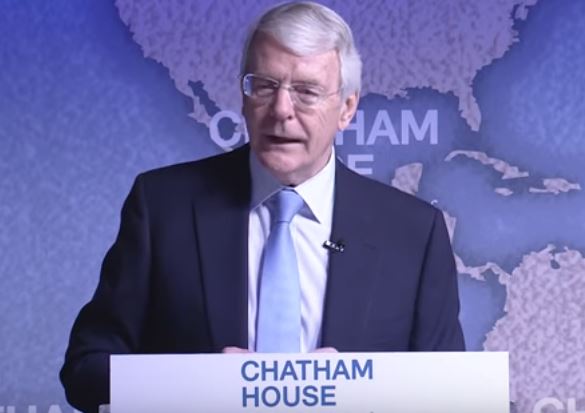

    BRITAIN AND EUROPE – A REALITY CHECK

    Eight months ago a majority of voters opted to leave the European Union. I believed then – as I do now – that was an historic mistake, but it was one – once asked – that the British nation had every right to make.

    The Government cannot ignore the nation’s decision and must now shape a new future for our country.

    Some changes may be beneficial: others may not. A hard Brexit – which is where we seem to be headed – is high risk. Some will gain. Others – will lose.

    Many outcomes will be very different from present expectations.  We will find, for example, that – for all the social pressure for immigration control – economically, we will need their skills.

    The Referendum was one of the most divisive votes in British history. It not only divided the four nations of our United Kingdom, but opened up divisions within those nations, within political parties, within neighbourhoods, within families, between age and income groups, and among friends.

    It will not be easy to heal those divisions and unite our nations. Yet that is what we must do.

    In Scotland, I believe a hard Brexit will encourage a second referendum on independence. This may seem improbable at the moment, but it would be reckless to ignore the risk.

    As we saw last June, emotion and national pride can overcome economic self-interest. If Scotland were to become independent, both she and the UK would be diminished. That cannot be ignored as Brexit evolves.

    The same is true of Northern Ireland. Many years of painstaking effort went into the Irish Peace Process which, even apart from Brexit, is at a fragile moment. Uncertainties over border restrictions between Ulster and the Republic are a serious threat – to the UK, to the peace process, and for Ireland, North and South. A special deal will be necessary.

    I will return to these issues on another occasion.

    As I voted on the losing side, I have kept silent since last June. This evening I don’t wish to argue the EU is perfect. Plainly it isn’t. Nor do I deny the economy has been more tranquil than expected since the decision to leave was taken.

    But I do observe we haven’t yet left the EU, and I have watched with growing concern as the British people have been led to expect a future that seems to be unreal and over-optimistic. Obstacles are brushed aside as of no consequence, whilst opportunities are inflated beyond any reasonable expectation of delivery.

    I am no longer in politics. I have absolutely no wish to re-enter it in any capacity. I don’t seek publicity – more often than not, I shy away from it.

    But I can’t ignore what I learned in Government. Nor can I forget the people who voted to leave Europe in the belief it might improve their lives. If events go badly, their expectations will not be met, and whole communities will be worse off. The particular fear I have is that those most likely to be hurt will be those least able to protect themselves.

    So, I have two objectives this evening: to offer a reality check on our national prospects; and to warn against an over-optimism that – if unachieved – will sow further distrust between politics and the public – at a time when trust needs to be re-built. It would be better to underplay than overplay expectations.

    The post-referendum debate has been deeply dispiriting.

    After decades of campaigning, the anti-Europeans won their battle to take Britain out of Europe. But, in the afterglow of victory, their cheerleaders have shown a disregard that amounts to contempt for the 48% who believed our future was more secure within the European Union.

    Remain voters are of all political persuasions, and of none. Over recent months, many have written to me in dismay –even despair.

    They are people from every walk of life who have every right to their view, every right to express it, and every right to have their opinion represented and tested in Parliament.

    This 48% care no less for our country than the 52% who voted to leave. They are every bit as patriotic. But they take a different view of Britain’s future role in the world, and are deeply worried for themselves, for their families, and for our country.

    They do not deserve to be told that, since the decision has been taken, they must keep quiet and toe the line. A popular triumph at the polls – even in a referendum – does not take away the right to disagree – nor the right to express that dissent.

    Freedom of speech is absolute in our country. It’s not “arrogant” or “brazen” or “elitist”, or remotely “delusional” to express concern about our future after Brexit. Nor, by doing so, is this group undermining the will of the people: they are the people. Shouting down their legitimate comment is against all our traditions of tolerance. It does nothing to inform and everything to demean – and it is time it stopped.

    Our Parliament exists to scrutinise the Executive. That is its job. So, it is depressing to see “Leave” enthusiasts in Parliament acting against their own principles. To win the Referendum, they asserted the sovereignty of our own Parliament: now, they speak and vote to deny that same Parliament any meaningful role in shaping, in overseeing, or in approving the outcome of our negotiations in Europe. Our Parliament is not a rubber stamp – and should not be treated as if it were.

    As a former Parliamentarian, I believe the negotiations to come are so crucial to our nation’s future that the Government would be wise to take frequent account of public opinion through Parliamentary debate.

    Of course, neither Parliament nor public can micro-manage the negotiations. We must trust Ministers to do so. And they must have flexibility.

    But Parliament must be free to debate and comment and advise. For it not to do so would be wrong in principle: it would also be unwise politically if – as it might – the will of the people evolves, and the reality of Brexit becomes unpopular.

    The hopes of those who favoured leaving the European Union are sky-high. We are told that countries “are queueing up to do trade deals with us”. That “our best days lie ahead”.

    It all sounds very enticing. And – for the sake of our country – I hope the optimists are proved right. But I’m not sure they will be. My own experience of international negotiations – and the national self-interest that accompanies them –makes me doubt the rosy confidence being offered to the British people.  

    Negotiations are all about “give” and “take”. We know what the Brexiteers wish to take: yet we hear nothing about what our country may have to give in return. If anyone genuinely believes that Europe will concede all we wish for –and exact no price for doing so – then they are extraordinarily naïve.

    As I consider the complexities that lie ahead, the words of Kipling come to mind:

    “I keep six honest serving men

    (They taught me all I knew);

    Their names are What and Why and When,

    And How and Where and Who.”

    It is the detail – the what and the why, the when and the how, and the where and the who – that is key. To avoid later recriminations, the British public needs to be made aware now of the hurdles ahead – and what different outcomes will mean for their future.

    Let me turn to the politics of exit.

    Leaving the European Union is not just about trade. It will have political consequences. For over forty years, British foreign policy has been based upon the twin pillars of our relations with the United States and the European Union. To be straddled between these two economic and political giants has served us well.

    Outside the European Union, we become far more dependent upon the United States and – for four and possibly eight years – upon a President less predictable, less reliable and less attuned to our free market and socially liberal instincts than any of his predecessors.

    As a boy, I was taught that America was our greatest ally and – throughout my life – I have seen her as so.

    But America’s size and power means we are, by far, the junior partner: mostly we follow – only rarely can we lead. Despite the romantic view of committed Atlanticists, the “special relationship” is not a union of equals. I wish it were: but it isn’t; America dwarfs the UK in economic and military power. That, sadly – is fact.

    Once we are out of the EU, our relationship with the United States will change. She needs a close ally inside the EU: once outside, that can no longer be us.

    That may not be the only change. If we disagree with American policy, we may weaken our ties. But if we support it slavishly, we become seen as an American echo – an invidious role for a nation that has broken free from Europe to become more independent.

    And – inevitably – there will be disagreements: the US wish to contain China and engage Russia; we wish to contain Russia and engage China.

    We seem likely to disagree also on refugees, free trade, the legality of Jewish settlements, and climate change. How many disagreements can there be before even the closest of ties begin to fray?

    Until now, the world has seen the UK as a leader within Europe. We are the second largest economy, with hopes of one day overtaking Germany. We are one of only two nations with significant nuclear and military power. We have the widest, and deepest, foreign policy reach of any European nation.

    In Europe, we have often set policy: the Single Market; enlargement to the East; restraints upon expenditure –together with a host of less prominent policies. Our role within Europe has magnified the power of our nation state: once we leave, that will no longer be so.

    The Prime Minister knows all this: her policy to maintain a good relationship with Europe is surely right. But, at some time, she will have to face down those who favour total disengagement – and who have never accepted our role within Europe.

    For some, a total divorce has been a decades-long ambition. I believe they are utterly wrong. And although – today –they may be allies of the Prime Minister, the risk is that – tomorrow – they may not.

    I am no dedicated Europhile. I said “No” to the Euro and “No” to Schengen on open borders. But I have never doubted the importance of co-operation with a successful Europe.

    And – in voting to leave – we have done the EU great harm.

    For the loss of the UK will weaken the EU – especially when set against the superpowers of America or China. For the first time, the EU is contracting not expanding. It is about to become smaller and less relevant. And, without the UK, it may change in character, becoming more protectionist and less of a pillar of free trade. Such a Europe would be damaging to British interests.

    Our departure is also adding to domestic political problems across Europe. Britain has rejected the colossus of the EU. This has energised the anti-EU, anti-immigrant nationalists that are growing in number in France, Germany, Holland – and other European countries.

    None of these populist groups is sympathetic to the broadly tolerant and liberal instincts of the British. Nonetheless, their pitch is straightforward. If Britain – sober, stable, moderate, reliable Britain, with its ancient Parliament and anti-revolutionary history – can break free of a repressive bureaucracy in Brussels, why, then “so can anyone”. It is a potent appeal.

    I caution everyone to be wary of this kind of populism. It seems to be a mixture of bigotry, prejudice and intolerance. It scapegoats minorities. It is a poison in any political system – destroying civility and decency and understanding. Here in the UK we should give it short shrift, for it is not the people we are – nor the country we are.

    Whatever grievances exist, the UK and Europe cannot ignore one another without mutual damage. As the Prime Minister has intimated, our future self-interest is to co operate on all aspects of security; on terrorism; on crime.

    We should take a common position on climate change; on human rights; and on representative democracy. We should continue to co-operate over the migrant surge to Europe and contain Russian misbehaviour.

    The plain truth is this: irrespective of Brexit, the UK benefits from engagement with Europe – not isolation from Europe – and both parties have an interest in ensuring that is maintained.

    My hunch is that, over the years ahead, the political price of leaving the EU may turn out to be greater than the economic cost.

    That said – to protect our interests – the trade negotiations will require statesmanship of a high order. There is a real risk the outcome will fall well below the hopes and expectations that have been raised: I see little chance we will be able to match the advantages of the Single Market.

    In my own experience, the most successful results are obtained when talks are conducted with goodwill: it is much easier to reach agreement with a friend than a quarrelsome neighbour.

    But, behind the diplomatic civilities, the atmosphere is already sour. A little more charm, and a lot less cheap rhetoric, would do much to protect the UK’s interests.

    The negotiations will begin with the costs of disengagement. These could be politically explosive.

    During the Referendum, the “Leave” campaign promised to “take back control” of huge sums of money, and pay an additional £350 million a week to the NHS.

    Many believed this, yet the bitter irony is that the “divorce settlement” – that is, the cost of leaving Europe – may involve paying out much larger sums of money than that.

    The EU Chief Negotiator has estimated that our bill for exit may total between €40 billion to €60 billion.

    I find this figure very contentious. But the bill will be substantial: billions, not millions, and very unpalatable. It will come as a nasty shock to voters who were not forewarned of this – even in the recent White Paper.

    One MP has referred to the estimated divorce payment as “a threat”, his argument being that “you pay to join a club but not to leave it”.

    Of course that is true: but when you leave any club, you are obliged to settle your debts, and that is what the European Union is going to expect the UK to do.

    There are liabilities to be met: pension costs, legacy costs, contingent liabilities, a proportional share of work-in-progress. The EU will argue we have a legal obligation to pay these bills.

    They may be right – but the issue is not clear-cut. Some of the EU’s claims are highly questionable and – unless there is a political agreement – any dispute may have to be resolved in Court. An agreement would be preferable and, if she sanctions one, the Prime Minister will deserve support.

    The EU Chief Negotiator has also warned that the separation costs must be agreed before any detailed trade negotiations can begin. However, I doubt he will be able to sustain such a hard line if we are prepared to engage in constructive talks: we shall see.

    But if there is a stand-off – perhaps because of a backlash against the size of the exit bill – then trade talks may have to await a Court decision, be delayed indefinitely – or scrapped altogether. In either event, the faint hope of a comprehensive trade deal by Spring 2019 will have gone.

    Without such a deal with Europe, three options arise:

      – we can leave the EU with a flimsy, inadequate deal; or

      – we can seek a transitional relationship – perhaps for 3-5 years – for which, as non-members, we would have to pay. A minimum option would involve staying in the Customs Union and submitting to the jurisdiction of the European Court of Justice; or

      – we can trade with the EU on a WTO basis.

    The more one examines probabilities, the more contentious becomes the task of leaving.

    Some of the most committed Brexit supporters wish to have a clean break, and trade only under WTO rules. This would require tariffs on goods – with nothing to help services, and nothing to inhibit non-tariff barriers. This would not be a panacea; for the UK – it would be the worst possible outcome.

    But – to those who wish to see us adapt to a deregulated, low-tax enterprise economy – it is an attractive option, and wholly consistent with their philosophy.

    However, it has worrying implications for public services such as the NHS – and for the vulnerable who, I’m delighted to say, the Government has pledged to help …. and I know how personally committed the Prime Minister is to this.

    So there is a choice to be made, a price to be paid; we cannot move to a radical enterprise economy without moving away from a welfare state. Such a direction of policy, once understood by the public, would never command support. It would make all previous rows over social policy seem a minor distraction.

    A new trade deal with Europe will be hugely complex. No-one should envy the Secretary of State and his negotiators. Some industries – cars and aerospace for example – hope for special, perhaps industry-to-industry, deals for their exports to Europe. The difficulties of this are legion: the chances of success are slim – not least since the German Chancellor is likely to rule out sectoral deals. Even if she does not, WTO rules expect agreements to cover all trade, not a few handpicked sectors.

    Many practicalities arise: even a partial customs deal with Europe would not eliminate the need for country-of-origin certificates. Or border checks. Or certification that regulations are met. Or other frustrations. And any deal must be agreed by 27 nations, each with their own national interests. No-one can be certain how long this will take: a conclusion within two years is very, very optimistic. Business needs to factor this in to their plans.

    Domestic political hurdles arise, too: if cars and aerospace were to get favourable deals, why not textiles and widgets? How would the Government soothe the ire of those not receiving preferential treatment?

    Nor will free trade deals with third countries be straightforward. Even the most attractive options come with political hazards.

    In Washington, the Prime Minister discussed a deal with President Trump. Both Leaders were keen, which is excellent. But the omens are mixed.

    Early actions confirm that President Trump has put protectionism at the heart of his trade policy. “America First” is more than a slogan.

    Tariffs between the US and the UK are already minimal: there is little scope for lowering them even further. The UK runs a healthy trade surplus with America: President Trump may wish to narrow – or eliminate – that gap. That being so, British hopes should not be set too high.

    Nor will it be easy – or quick – to reach agreement on contentious issues such as medicine, or cars, or beef raised with growth hormones. In comes American beef: Out go European subsidies. That won’t be an easy sell to the beef industry.  

    China and India are both attractive candidates for enhanced trade. But, in negotiation, India will seek immigration concessions for students and non-students alike which, prima facie, is in direct conflict with Government plans.

    China, as I know from experience, is a tough negotiator, and will strike a hard bargain. As she is the largest trading partner to 120 countries, and the largest export market for 70 of them, a trade agreement with the United Kingdom may not be one of her main priorities.

    The Government must also replicate the 53 deals struck on our behalf by the European Union. So far, only 12 are in play. There is a very, very long way to go, and the question arises: are 65 million Britons likely to get the same favourable outcome as 500 million Europeans?

    I set out these difficulties, not because I don’t think deals can be done – some certainly can – but to be realistic about the timescale and complexity of the huge undertaking that lies ahead. It is crucial to business and the public – that our expectations are consistent with what can be delivered. It matters to the Government, too: Ministers must not over-promise.

    In two years’ time, the UK will be the first nation to leave the EU. This will be a real irony, as the first proposal for a European Union came not – as is generally supposed – from the Frenchman, Jean Monnet, but from an Englishman.

    Three and a quarter centuries ago, in 1693, William Penn advocated a European “Dyet or Parliament” as a policy to end perpetual military conflict on the Continent. It took 280 years and two world wars to convince his fellow Britons.

    43 years later, the British people reversed that decision.

    Let us hope – for the futures of our children and grandchildren – they were right.

  • Sir John Major’s Speech in Northern Ireland – 9 June 2016

    Below is the text of the speech made by Sir John Major in Northern Ireland on 9 June 2016.


    Let me start by saying how pleased I am to be back in Northern Ireland, and with you this morning.

    Tony and I are here to talk about the European referendum, and why it matters for you, for Northern Ireland, for Anglo-Irish relations,
    …and for the future of our United Kingdom as a whole.

    In a moment, Tony will talk specifically about Northern Ireland, but I want to take a step back and ask: what’s this referendum really all about?

    First, it’s about the economy, jobs and the wellbeing of everyone in the UK.

    Just like Prime Ministers before us and since, Tony and I fought hard to persuade our fellow European leaders to continue to build the Single Market: we did so because it is of huge benefit to Britain. It is the richest free market in the world and we have full access to it: that is enormously valuable for our prosperity.

    To risk losing it – or reducing our access to it – seems to be pure folly.

    Secondly, our security and strength on the world stage is also vital.

    If we work with our partners in Europe we can achieve things in the British interest that we cannot do alone.

    I know that immigration remains a concern for people – but, in my view, that would remain a contentious issue whether we were in or out of Europe.

    It is a difficult and complex problem, but there are no simple answers to it, no magic bullets that solve it.

    But – this morning – I want everyone here to understand something else – something that is critical in this debate – and for all our futures.

    This referendum is also about the people in every part of the United Kingdom, and the union that we have built together over generations.

    That’s important to all of us – it’s about the ties of friendship, family and affection that bind us together.

    Men and women; friends and neighbours; workmates and classmates…

    …all of us living together side-by-side in a union of four countries: England, Scotland, Wales and Northern Ireland.

    And I say without a shadow of doubt in my mind, that the wrong outcome on June 23rd will affect our union; and will jeopardise that unity.

    That means the unity of the United Kingdom itself is on the ballot paper in two weeks’ time.

    Let me explain.

    First, Scotland.

    Two years ago, on the eve of the Scottish Referendum…

    …thousands and thousands of people gathered in Trafalgar Square to wave Union Jacks and sing songs together – imploring the Scottish people not to vote for independence.

    It was a last-ditch appeal, an emotional plea, from the English, the Welsh and the Northern Irish to stick together, to stay together – to preserve the most successful union in history.

    Wisely, the Scots did so – against the advice of the SNP.

    I believe that, with one qualification, the matter is now settled for a generation and beyond.

    But it is a very big qualification.

    Because if Scotland votes to stay in the European Union, but the UK as a whole chooses to leave, there is a serious risk of a new referendum…
    not straight away, perhaps– but ultimately nationalist pressure for another shot at leaving the UK could prove to be uncontrollable and irresistible.

    And in those circumstances – if the UK was outside the EU – I can well envisage a different result.

    That is the risk … that a British exit from the EU could re-open the whole question, and tear apart the United Kingdom.

    So I say to everyone who is undecided, everyone who is wavering: please understand the potential – even the likely – consequence of a vote to leave the EU.

    Not just a shrunken economy, not just a diminished United Kingdom on the world stage; but a smaller country in a very real and literal sense.

    The most successful union in world history would be broken apart for good.

    That appalling outcome could follow the wrong choice on June 23rd.

    But of course there is also the question of Northern Ireland – itself a vital part of the Union.

    Tony and I know more than most how carefully the peace process was stitched together over many years.

    We met the families of the victims, whose pain when their loved ones were murdered was raw and real – and, I imagine, still is.

    We know about the stops and starts of that process; the setbacks; the compromises and the contradictions that are inherent in building a peace that can endure.

    I think back to working with my friend, Albert Reynolds, and the breakthrough that was the Downing Street Declaration, sowing the seeds for the IRA ceasefire and then the chance – in time – for a negotiated and peaceful constitutional settlement. I carried this forward: Tony completed it.

    Throughout my years as Prime Minister, no issue consumed my thoughts and my attention more than the goal of peace and stability here.

    I was convinced that, however intractable the Troubles seemed…

    …however routine the daily cycle of violence became…

    …however deeply the hatred was felt….

    …that a solution could and must be found.

    That with patience, care and hard work, we could find a way. Many people, both well-known and unknown, helped in that endeavour.

    I pay tribute to Tony for all that he did, to the Irish government…and to all parties here in Northern Ireland for having the strength and commitment to see the Process through. And to the communities, here and in the South, who were sick of violence and wanted a better future.

    And it is an incredible achievement to see a successful power-sharing executive working in Northern Ireland – a dream thought impossible 30 years ago.

    Indeed, it is a mark of the progress made in Northern Ireland that, today, elections are now conducted with more courtesy and good humour than many other campaigns I can think of.

    So I believe it would be a dreadful mistake to do anything that has any risk of destabilising the complicated and multi-layered constitutional settlement that underpins stability in Northern Ireland.

    But that is what a British exit from the EU would do: it would throw all of the pieces of the constitutional jigsaw into the air again, and no-one could say where they might land.

    We can all be proud at what Northern Ireland has achieved … but we should never take the very good state of Anglo-Irish relations for granted.

    Today, relations between the UK and Ireland have never been better.

    And though I’ve no doubt – whatever happens – that they will remain cordial, I do worry about the prospect of a British exit, which would leave Ireland on the other side of the table in a new negotiation between Britain and 27 other EU countries.

    I fear that would have a totally negative effect on the relationship between our two countries.

    And there is also the severe economic damage that leaving would cause in Northern Ireland and the Republic of Ireland alike.

    And all of the issues that we thought were completely settled – like the Common Travel Area – would suddenly be thrown into real doubt.

    In a moment, I will hand over to Tony to talk in more detail about Northern Ireland but, before I do so, let me end by saying this: here you have two former Prime Ministers from two different parties. Rivals on many occasions, but never over the Peace Process for Ireland; never on the unity of the UK; never on the importance of our relationship with Europe.

    It’s not a coincidence that every living former Prime Minister, and the current Prime Minister, shares the same view about Europe.

    We know, because we have sat at the top European table that despite its many frustrations, our membership of the EU magnifies Britain’s influence in the world, and significantly improves the living standards of the British people.

    And we are in no doubt of this: our membership is also an absolutely vital part of our finely-tuned and carefully-preserved union.

    Throw away the membership of Europe, and don’t be surprised if – in the end, as a consequence – we accidentally throw away our union as well.

    Please don’t put that at risk.

    Make a positive and patriotic choice to remain – choose to fight for the UK’s interest in Europe, and in so doing, safeguard the UK’s interests at home as well.

    That’s the right choice for our country, and for our future.

    In two weeks’ time, I hope it is the choice we will all make.

    And with that, let me hand over to Tony.

  • Sir John Major’s Speech at the Oxford Union on the UK’s EU Membership – 13 May 2016

    Below is the text of Sir John Major’s speech at the Oxford Union made on Friday 13 May 2016.


    SIR JOHN MAJOR:

    This is my first formal speech in the Referendum campaign, and it is appropriate that it is here – because it is your generation’s future that will be enhanced or diminished by whether we “remain” in or “leave” the EU.

    I’ve no particular reason to be a supporter of the EU. It is far from perfect. A quarter of a century ago it bitterly divided my Party, and European disagreements wrecked many of the ambitions I had as Prime Minister. It opened disputes that linger yet. Nor am I an unquestioning European: I did, after all, say “No” to the Euro, and “No” to joining the Schengen Agreement on open borders.

    Even so, I passionately believe we must remain in Europe and help shape its future: geography, trade and logic mean our futures are linked whether we wish it or not.

    Tonight I want to explain why I believe that is so, and then cast a critical eye over the flawed – and misleading –arguments for Brexit.

    What sort of country are we? For hundreds of years we’ve been a positive force in the world – a nation that looked outwards, and spread our ideas, our principles, our laws, our democracy, across the world.

    But that world has changed. Today, we are 65 million people: less than 1% of a world of 7,000 million, forecast to become 9,000 million by the time your own children are at University.

    And the global market is inexorably drawing that world together on a scale we could not have imagined even a few years ago. It is counter-intuitive to try to go it alone and, as our friends around the world tell us, a disastrously bad decision to do so.

    Within the EU, we are a large and influential nation and – while we remain a part of a Union of 500 million people – we have serious political and diplomatic clout, as well as economic advantages. Some examples make this clear.

    In Europe, we were able to impose sanctions on Russia to keep her in check, and deter further misbehaviour in Ukraine. We persuaded the EU to join America and impose sanctions on Iran, to bring about a deal that halts development of a nuclear weapon. We could not do this alone. If we were to leave, the world would consider us diminished. Departure would be a gratuitous act of self-harm.

    The economic argument for Europe is overwhelming: it is nearly half our export market, and nearly five times bigger than all the 52 Commonwealth countries added together, or indeed, six times more than the sum total of trade with Brazil, Russia, India and China.

    In the EU, we have unimpeded access to the richest trade market in the world – right here on our doorstep. Access to that market of 500 million people encourages a wealth of investment into our country. That’s not an abstract statistic –it’s people’s jobs, taxes, profits and overall quality of life.

    Outside Europe, we would still have to comply with EU rules and regulations, unless we surrendered all access to the Single Market – which all reputable authorities, not least the IMF, OECD, NIESR and the Bank of England, regard as economically foolish.

    And, once out – or “liberated” in the more emotive language of the “Leave” campaign – we could no longer protect ourselves against the impact of EU laws on the City of London, nor on our industry and service sectors.

    Nominally, we would indeed be “free”, but – in practice – we would only be “free” to accept whatever the EU determined, with no power to argue against it. Is that “taking back control” – as the “Leave” campaign describes it? No it isn’t. And it’s not glorious sovereignty either. It is nothing other than reckless, imprudent folly. And the price for that would be paid by every British family.

    It is not the only price. The NIESR warns of a collapse in the value of Sterling. The LSE warns of higher prices. The Bank of England fears higher interest rates and mortgages. All this and more – from independent bodies – is ignored and brushed aside by the “Leave” campaign.

    Yet many people – not least in my own Party – wish to leave.  

    Their motives are many and variable: pride in our country, concern over sovereignty and immigration, and fear that we have no influence in Europe and are heading towards a federal structure.

    We must address these instincts, these emotions, and debunk myths that are wrong, but sunk in our national consciousness. If we fail to do so, we may end up leaving Europe because absurd falsehoods are widely believed to be true.

    One absurdity is that, subsumed in Europe, we would lose our traditions, our heritage, our individuality. We won’t: after sixty years of Europe are the French less French or the Germans less German? Of course not: and nor will we be less British.

    In the search for voter support the “Leave” campaign repeatedly overstate their case: if they were to win, they risk a backlash from those who reasonably might say they were misled.

    There is no shortage of such exaggerations. One clear example is the cost of Europe. Nigel Farage, Iain Duncan-Smith and Boris Johnson all put it at £20 billion a year; Michael Gove is more modest at £18 billion (£350 million a week), all of which, they tell us – if only we could be free of Europe – would be spent on the Health Service and our hospitals.

    If only … if only…. but the truth is their figures are wrong by a factor of over three! During the last five years the average gross payment was £12.7 billion of which £5.6 billion was paid back to us. Last year, our gross payment was just over £11 billion, of which over £5 billion was paid back to our farmers, businesses, science, research and regional aid. This is not my calculation – it is the calculation of the Institute for Fiscal Studies.

    So, to put £20 billion more into hospitals the “Leave” campaign would have to claw back all the money paid to some of our fellow countrymen and, on top of that, tax us all by an additional £10 billion. Those who make such false claims – and knowingly do so – need to apologise that they’ve got their figures badly wrong – and stop peddling a demonstrable untruth – as they have been repeatedly asked to do by the Chairman of the UK Statistics Authority.

    The “Leave” campaign fret that we have surrendered our “sovereignty” to Europe. That is a very rum claim: and – if it were true – how could we offer our nation a Referendum? It is certainly true that we have shared sovereignty: we share ours and, in return, we gain a share of the sovereignty of 27 other nations.

    But this is our choice – because it is in our own national interest. And, if it ever ceased to be, our Government can always commence withdrawal with Parliament support. So let me make the position on sovereignty absolutely clear: we share it within the EU only for as long as our British Parliament wishes us to do so.

    And even that sharing is partial.

    What say does the EU have over our economic policy? None.

    Our education system? None.

    Our NHS? None.

    Our welfare system? None.

    Our Armed Forces? None.

    Our police? None

    I could go on: 98% of government spending is entirely in the control of the British Parliament.

    Like much we hear from the “Leave” campaign, the sovereignty argument is emotive but specious. In a global economy, no country truly has sovereignty – not even our mighty friend the US. And in our most crucial area – security – we have happily shared sovereignty within NATO for over 60 years.

    Of course, we don’t always get our own way. Who does in any relationship of two – let alone one that numbers 27 other Member States? But we should not forget that – in well over 90% of the votes cast in Brussels – the UK wins. The caricature that we are repeatedly voted down in Europe is ill-informed nonsense.

    Another cherished “Leave” mantra is that we will all be “dragged” into a “federal” Europe. It is their favourite horror story. But, yet again, it is fantasy.

    Were we dragged into the Euro? No

    Were we dragged into Schengen and open borders? No

    Are we now exempt from “ever-closer union”? Yes, we are.

    And if any new Treaty seeks more power, that Treaty would have to be put to the British nation in a Referendum and if – and only if – it were approved by us would it become law.

    A final point on sovereignty: we have sovereignty in its purest and most potent form: we – the UK – can leave the EU at any time; nothing legally binds us to the EU forever. That is the fact and we should disregard the fiction.

    As the “Leave” arguments implode one by one, some of the Brexit leaders morph into UKIP, and turn to their default position: immigration. This is their trump card. I urge them to take care: this is dangerous territory that – if handled carelessly – can open up long-term divisions in our society.

    I grew up in Brixton in the 1950s – a time of massive West Indian immigration. As a boy, I played in local parks with the children of migrants.  Some of these newcomers rented rooms in the same house as my family.

    So, I can tell you, as a matter of fact, not fantasy, that those I knew then – and later – didn’t come here for our benefits: they came half-way across the world to give themselves and their families a better life.

    But, at the time, fears were fanned by careless statements from political figures. That was a mistake then, and would be a mistake now.

    Do not misunderstand me. Of course, it is legitimate to raise the issue of the sheer number of those wishing to enter our country. I wholly accept that. Nor do I wish to silence debate. We mustn’t overlook genuine concerns: but these should be expressed with care, honesty and balance. Not in a manner that can raise fears or fuel prejudice. The “Leave” campaign are crossing that boundary, and I caution them not to do so.

    They attribute motives to new arrivals that are speculative and, frankly, offensive. They highlight – with grotesque exaggeration – the risk of mass migration from Turkey – which is unlikely to be joining the EU any time soon and indeed may never do so. And – even if she did – the terms of her accession would need to be agreed by every Member State.

    So, when the “Leave” campaign warn of “opening our borders to 88 million” (meaning Turkey and the Western Balkans) they cross the boundaries of responsible comment. It is unlikely in the extreme that – I quote – “another 88 million people will soon be eligible for NHS care and school places for their children”.

    I assume this distortion of reality was intended to lead the British people into believing that almost the entire population of possible new entrants will wish to relocate to the UK. If so, this is pure demagoguery. I hope that – when the heat of the Referendum is behind us – the proponents of such mischief making will be embarrassed and ashamed at how they have mis-used this issue.

    They advance a second migration red herring – that the recent modest rise in our National Living Wage will be “irresistible” to would-be migrants.

    This is very dubious. First of all, 40% of all migrants are under 25 and therefore ineligible.

    Second, are people really motivated to cross an entire Continent to receive a few pence a week extra? I very much doubt it.

    But even if they were – why would they choose the UK, when the minimum wage is higher, for example, in France; and wage levels higher in other countries that have no statutory minimum.

    And what of the “numbers” argument?

    There are various categories of immigrants. Commonwealth immigration is entirely unaffected by our membership of the EU.   

     Would-be migrants from around the world need skilled worker visas to enter: and these are under our control.

    Refugees are dealt with on a case by case basis. Many of those applying for citizenship have lost everything, and we have always been a compassionate nation.  But these decisions are under our control.

    But there are clearly undesirables, who we can – and already do – exclude. This includes anyone where there is concern over national security, criminal activity or adverse immigration history. This, too, is already under our control.

    But yes, if we were to leave Europe, we could exclude more EU citizens – such as the 54,000 EU migrants now working as Doctors, or Nurses or Ancilliaries in our Health Service, or the nearly 80,000 working in Social Care. We could exclude skilled workers like builders and plumbers – or unskilled labour that takes jobs that are unappealing to the British. In short, the people we could most easily keep out are the very people we most need.

    A balanced approach would acknowledge the contribution of migrants to our national wellbeing. Without their contribution, the Health Service would not be able to cope – nor would our public transport system; and our hotels, restaurants and shops would be without staff to serve their customers. We would have a shortage of many skills for industry. This is the reality of what lies beneath the emotive language of those who seek to raise the drawbridge on our country.  

    This problem of numbers will not be forever. The growth of the Eurozone economy – now clearly underway – should cut demand to come here, as jobs grow elsewhere across Europe. And, in any event, a short term migrancy flow should not be the issue that drives the UK out of an economic union that already benefits our country immensely –and will continue to do so in the future.

    I asked earlier: what sort of country are we? And what sort of people are we?

    Under our undemonstrative exterior we are an essentially kind and benevolent nation, and more inclined to emotion than the age old caricature of stiff upper lip.

    Show us charitable need and we dig deep.

    Show us children in need, and we pay up happily.

    Show us people starving in Africa, and we text our contributions by the million.

    Show us a far away nation suffering from natural disaster, and we rush to help.

    We do so because our emotions are touched. But we should not let those emotions be stirred by false fear: nor allow false fear to impair our judgement on the future of our country.

    Over the next few weeks we – the British people – will decide the future direction of our country.

    This is not a General Election which rolls around every five years: we can’t “suck it and see”. There will not be another Referendum on Europe. This is it.

    So – whatever your view – register and vote. Because the decision you take on the 23rd of June will shape our country, our people, and our livelihoods for generations to come.

  • Sir John Major’s Speech in Hong Kong on the UK’s EU Membership – 7 April 2016

    The text of Sir John Major’s speech in Hong Kong made on Thursday 7 April 2016.


    SIR JOHN MAJOR:

    During the last few days in Hong Kong I have been asked repeatedly whether the UK will leave the European Union.

    Almost without exception, the questioners – often investors in the UK – believe it is a bad idea. I will not quote their warnings given to me in private, but let the public remarks of Hong Kong’s Li Ka Shing, a large investor in the UK, speak for many:

    “If Brexit really happens”, he said on Bloomberg, “we will surely decrease our investments.”.

    Mr Li is not alone. As we move towards the referendum in June, the UK has been warned against exit by – amongst others – China, Japan, America, New Zealand and Australia; by the G20; the Governor of the Bank of England; our military leaders; our leading academics and scientists; and a majority of large and small businesses.

    In response, the advocates of Brexit accuse all these sources of “interfering” if they are foreign; or “scaremongering” if they are British.
    The “Out” campaign label such warnings – even from distinguished friends of the UK – as “Project Fear”. I disagree. In truth, it is Project Reality – and the British people have a right to be told what is likely to happen if the UK were to leave the EU.

    Let me set out my own position.

    As Prime Minister I refused to join the Euro currency. I believed it to be premature and risky. I also opted out of the Social Chapter since, at the time, it seemed to give rights to those in work, at the expense of denying work to the millions who were not. And – when it was first introduced – I refused to enter the Schengen agreement on open borders.

    I am, therefore, no starry-eyed European enthusiast. Yet I have not a shred of doubt that the UK should remain a Member of the EU.
    The case for remaining is most often seen in economic terms. But it is far wider than that. The outcome of the UK Referendum will decide what sort of country we are – and what our wider contribution to the world will be.

    When the UK joined the then Common Market our economy was the “sick man” of Europe: today, as a result of our domestic reforms, together with our membership of the European Single Market, we have the best performing economy in Europe.

    Within the next 20 years – on present policies and, crucially, with continuing full access to the Single Market – the UK is likely – not certain, but likely – to be the biggest economy in Europe: bigger than Germany.

    On issues such as the environment, climate change, internet costs and consumer protection, the UK can best progress – or sometimes, only progress – in unity with our fellow Europeans.

    The underlying mantra of the “Out” campaign is – and I use their words – “I want my country back”. It is an emotional appeal, but a bogus one.

    If emotion triumphs over reality, then all four British nations will lose out: England, Scotland, Wales and Northern Ireland. We will lose power, prestige, security and some of our future economic well-being.

    At present, our world is very disturbed. Uncertain. Across Europe, the scales have fallen from our eyes over President Putin. We see Russia threatening her neighbours with trade embargoes, cyber attacks, energy cut-offs, and encouraging pro-Russian minorities to ferment trouble.

    I am not, and never have been, a Cold War warrior, but we ignore what Russia is doing at our peril.

    A united Europe can help penalise and deter her: a disunited, shrivelled Europe cannot.

    The faults and frustrations of the EU are widely publicised in the UK: its achievements, less so. But they should be. Across Europe, ancient enemies of many years no longer fight against each other – they work alongside each other.

    The EU was the magnet that helped Spain, Portugal and Greece free themselves from fascist dictatorships. It helped the political climate that brought about the Northern Ireland Peace Process.

    It helped re-build and heal the Balkans after a terrible conflict. And enlargement of the EU has brought a new future to countries once imprisoned within the Soviet Empire. So, when we criticise the shortcomings of the EU, we should also remember its considerable successes.
    If the UK leaves the EU, the impact will be felt widely – and negatively – not only in the UK but across the EU.

    If the UK departs, the EU will lose:

    – its fastest growing economy;

    – one of only two nuclear powers; and

    – the country with the longest and deepest foreign policy reach.

    As a result, the EU would be gravely weakened, especially when set against the power of the US and China. Europe – the cradle of modern civilisation – would bow out of super-power influence.

    Does the UK really wish to be the cause of that? Does she really wish to abdicate her role in European and global influence? I truly think not – but many enthusiasts for exit either cannot see the danger – or are prepared to run that risk.

    The point is this: a UK departure would not only be a huge setback for my own country, but for many other nations too. It would have widespread repercussions – and no-one can be sure what they will be.

    For Europe, already facing internal and external crises, it could be one crisis too many.

    There are hard questions for the UK too, and it is more appropriate for me to raise these in detail at home, rather than overseas. But some are directly relevant to our global trading partners.

    Would external investors – China, Japan, America, be more or less likely to invest in the UK if she shrunk to a domestic market of under 65 million, rather than remaining inside a Europe-wide market of over 500 million?

    That is not a difficult question to answer. The UK would lose investment and jobs. How much, how many, and how soon is difficult to say – but there is no doubt that would happen.

    In the referendum debate, the advocates of leaving claim they can negotiate an arrangement to protect our trade relationship with the EU. After all, they say, the EU needs us because they – the EU – export more to the UK than the UK exports to them. It’s a beguiling soundbite, but they are deceiving themselves.

    Their argument is, to put it kindly, disingenuous: more accurately, it turns the truth on its head.

    UK exports to Europe are between 40-45% of all our exports: 14% of our overall wealth. On average, across the EU, the other 27 Members States only send 7% of their total exports to us: 2½% of their overall wealth.

    In the game of who needs who the most, the answer is clear. If the UK exits the EU, our partners will not be the demandeur in any negotiations on our future access to the single market – the UK will be.

    Moreover, it is blithe optimism on a Panglossian scale for the “Out” campaign to assume our partners – having been rebuffed, deserted and weakened – will still feel so well disposed toward the UK that they will be eager to accede to our demands.

    I fear the reverse will be true. A divorce, at the behest of one partner, is rarely harmonious – or cheap. Such a broken relationship is more likely to be full of rancour.

    The UK will have chosen to leave and, by so doing, will have gravely weakened the whole EU. Some countries will see fifty years of ambition imperilled – and our partners will hardly wish to reward us for that.

    Any trade deal the EU might eventually do with us would certainly not be a sweetheart deal: and it may be harder and harsher than the optimists believe.

    And if we wished such a deal to include services (and we do – since they represent 80% of the UK economy) – or the removal of hidden non-tariff barriers – it may be a long time coming, not least since it would need the approval of 27 other Member States – many of them angry and disappointed at our departure.

    And, of course, the UK would have to accept free movement of people. If we refuse that – there will be no trade deal at all – as Germany, for one, has already made clear.

    The UK will face another dilemma with its international trade.

    By leaving the EU, we would be withdrawing from Free Trade Agreements with 53 countries negotiated by the EU on behalf of all their Member States. These cover 60% of all UK trade.

    They will all need re-negotiation: a tough – and almost certainly lengthy – process. It is pure self-deception to believe that less than 65 million Britons will get the same favourable terms as 500 million Europeans.

    Nor will bilateral renegotiations of these Free Trade Agreements be a priority for other nations – as America, for one, has made clear.

    Our partners are more concerned with multilateral trade agreements, and will see the UK’s need for a speedy bilateral deal as a self-imposed own goal: we may well have to wait our turn to have any new deals agreed – and it could take many years.

    To brush aside such realities is to play Russian roulette with the economic future of the UK.

    The battle now joined over Europe has – on one side – the romantic nostalgia of an “Out” campaign that aches for a past that has long gone, in a world that has moved on.

    On the other side those – like me – who wish to remain are not European dreamers: we are realists who see an edgy, uncomfortable world, and believe that the UK is safer, more secure and better off remaining with our partners in Europe.

    In the Referendum, the easiest slogans inevitably lie with the “Out” campaign, and repudiating their often foolish and extreme claims is for a UK audience. Suffice to say, the “Out” advocates, whether in enthusiasm or ignorance, lace their argument with false statistics and unlikely scenarios.

    They promise negotiating gains that cannot – and will not – be delivered. They hail the purported gains of leaving Europe, whilst ignoring even the most obvious obstacles and drawbacks.

    Nor can they tell us how they actually see the UK outside of Europe. This is simply astonishing, not least since some of them – for over a quarter of a century – have made a career out of wishing to leave the EU. Yet now they have the opportunity to do so they seem bereft of any real detail.

    Some wish to have no relationship at all with the Single Market. Others can’t – or won’t – say what relationship they favour: 25 years of planning, and they still have no idea. Instead, they engage in shrill denunciation of what we have, with no indication of what would replace it.
    I understand the frustration that fuels the “Out” campaign, but have no doubt that an exit from the EU would harm our nation, now and in the future. We must not let an emotional spasm of faux-patriotism overcome the realities of the modern world and spin us out of Europe.
    We would soon regret it. And our children and grandchildren would regret it even more.

    That is why – between now and June – I will be doing all I can to persuade the British people that the consequences of our leaving the EU would be bad for the UK, bad for Europe, and bad for the wider world.

    I hope and believe that – on 23 June – good sense will prevail, and we can finally lay this particular ghost to rest. I have no doubt that, once it is, our international investors will breathe a large sigh of relief … as most definitely will I.

  • Article on the EU Referendum – 19 March 2016

    The text of Sir John Major’s article on the economy, published by The Sunday Telegraph on Sunday 19 March 2016.


    SIR JOHN MAJOR:

    This June, the UK will vote upon whether to leave or remain in the EU. This vote will be momentous. It will decide Britain’s place in the world for generations to come.

    There are many positive reasons for membership.

    When we joined the EU we were the “sick man” of Europe: today, as a result of our domestic reforms and membership of the European Single Market, we have the best performing economy in Europe.

    Within the next 20 years – on present policies, and with continuing full access to the Single Market – the UK is likely to be the biggest economy in Europe.

    And surely – in a global market drawing ever closer together – it is verging on the reckless for us to seek divorce from the world’s pre-eminent trading bloc?

    On issues such as the environment, climate change, internet costs and consumer protection, the UK can best progress – or sometimes only progress – in unity with our fellow Europeans.

    In an uncertain world the UK, as part of the EU, is better able to face up to the aggressive policies of hostile nations. We are safer, because the EU has brought together former enemies to face common perils. In the last thousand years of history, no previous generation has been so fortunate.

    It would be sheer folly to put this all at risk.

    Beyond the positive advantages of membership, we have protection from many aspects of the EU that we dislike: we are not in the Eurozone – because I kept us out of it over 20 years ago; we are not part of Schengen (and thus have control of our borders); and we have opted out of “ever closer union”. We can veto any Treaty that enhances EU powers.

    We are the only nation within the EU which has managed to secure these concessions. It would surely be perverse to turn our back on these advantages, and replace them with serious risks that alarm our international friends and repel the inward investments that boost our jobs and living standards.

    Suppose we left? What are the risks? They are many and real – and simply cannot be brushed aside with flippant slogans such as “Project Fear”.

    Consider this: as a Member State, the UK can (and does) influence European policies – often to our advantage, and sometimes simply to minimise damage to our own domestic interests. Outside, we would not be able to influence them at all. And yet, if – as a non-Member – we wish to retain access to the Single Market, we will be compelled to follow EU rules, over which we would have no influence at all. This is not only demeaning, it is a recipe for economic self-harm.

    The “leave” campaign blandly assumes that once they have undermined – if not wrecked – the power of the EU by leaving it, they can simply re-negotiate all the advantages of membership with pliant Europeans eager for our trade. This is self-deception to the point of delusion. Their argument is that the EU needs the UK market more than we need theirs, on the basis that – overall – the EU exports more to the UK than we export to them. This is, at best, disingenuous. More bluntly, it is fantasy.

    UK exports to Europe are nearly 45 per cent of our total exports. On average – across the EU – the other 27 Member States send only 7% of their total exports to us. In the game of who needs who the most, the answer is clear. Our European partners will not be the demandeur in any negotiations on the Single Market – we will be.

    Moreover, if we left, it is blithe optimism on a Panglossian scale for the “leave” campaign to assume that our partners – having been re-buffed and deserted in an EU diminished by our departure – will be well disposed and eager to accede to our demands.

    I fear the reverse will be true. Resentment will be deep. The broken relationship is more likely to be poisonous than harmonious. The UK will have chosen to leave and, by so doing, will have gravely weakened the whole of the EU. Our partners will not wish to reward us for that – indeed, they may well be more inclined to resist our demands to discourage other nations from leaving it.

    In time, the EU will no doubt do a trade deal with us – but it will certainly not be a sweetheart deal: and negotiating it is likely to be harder and harsher than the optimists believe. And if we wish such a deal to include services (such as banking and insurance), or to prevent hidden non-tariff barriers – which we do since both are crucial to our wellbeing – it may be a long time coming.

    Of course – and “leave” campaigners please note – the price of any deal with significant access to the Single Market is that we will be forced to accept free movement of people, and pay into the EU budget. Without that, as Germany’s Finance Minister has made clear, there will be no deal. These are realities that the “leave” campaign must face up to and address, so that the British people are able to reach their decision based on facts. Instead, they ignore – even obscure – the facts, to hide the weakness of their case.

    “Give us our country back” is an emotional appeal that warms the heart of all those who love our country, as I do. But it is a meaningless soundbite. An illusion. A prelude to disappointment. And what country, exactly, will we “get back”? Will Scotland remain part of the UK? As a Unionist, I hope so – but no-one should ignore the threat that if the UK-wide vote is to leave, Scotland may demand another referendum on independence. The UK out of the EU and Scotland out of the UK would be a truly awful outcome.

    Let everyone be clear, no-one can be certain of the scale of the fallout from leaving the EU. But there are many legitimate risks, and not even the most optimistic “leave” advocate can wave them away. We have been warned against exit – by America, China, Japan: are all these large investors in the UK to be ignored? Should we also ignore the G20? The Governor of the Bank of England? Our military leaders? Our leading scientists and academics?

    A majority of large and small businesses? Are they really all guilty of “interfering”, “scaremongering”, or being part of one enormous plot being orchestrated by Number 10? Such a notion is absurd.

    Would we remain such a pre-eminent ally of the United States if we no longer had influence in the EU? Close, yes – because of trade; important, yes – because history matters; but outside the EU, part of our influence would wane. In our absence, the US would need a powerful friend within the EU – and it could no longer be us.

    Our departure would not only weaken the UK but Europe, too. If the UK leaves, the EU will lose:

    – the fastest growing economy in the EU;

    – one of only two nuclear powers;

    – a country with the longest and deepest foreign policy reach.

    As a result of a UK exit, the political influence of the EU would be diminished – especially when considered against the power of the United States or China. Without the UK, Europe – the cradle of modern civilisation – would fall to a lower significance. I cannot believe that any sensible Briton wishes to divide Europe, and thus divide the West: only our enemies could gain from that, as Senator McCain has made clear in recent days. No doubt the “leave” campaign will accuse him of “scaremongering” too.

    The Referendum decision on 23 June is not a prelude to further negotiation. It will be final. Our nation can either decide to be true to our history – and remain outward-looking internationalists on the world stage – or shrink to lower prominence.

    It will be a fateful choice: Great Britain or Little Britain.

    As our children and grandchildren look back at this pivotal moment in our history, I hope they can be proud that, in a world of uncertainties – of Daesh, of Syria, of Putin’s Russia – our country did not turn its back on Europe and cripple its authority, but chose to remain in it, reform it, and play our part in maximising British influence and European power for the common good.

  • Sir John Major’s Interview on the Andrew Marr Show – 20 December 2015

    The text of Sir John Major’s interview on the BBC’s Andrew Marr show, broadcast on BBC1 on 20 December 2015.


    ANDREW MARR:

    Now then, it’s 25 years since in the most dramatic circumstances Sir John Major became leader of the Conservative Party and Prime Minister, and you could say the Tories have never really resolved the issue which ultimately led to his predecessor Margaret Thatcher’s fall from power – namely the party’s attitude to the European Union. Sir John wrestled with it during his premiership. He also had to deal with war in the Middle East, a recession, global economic uncertainty. It sounds just a tad familiar, Sir John. Thanks for coming in.

    SIR JOHN MAJOR:

    My pleasure.

    ANDREW MARR:

    Let’s start talking a little bit about the economy and so forth. I remember when I was a very young reporter and you were a very young Prime Minister, there was a kind of asset bubble thing going on and then interest rates ticked up and we had all sorts of problems with negative equity and so forth. Now interest rates are clearly on the move up again, led by the Fed. We have a very, very problematic asset bubble in terms of house prices in the UK, which is leading to inequality as we were talking about. I’m just wondering on your reflections. Twenty-five odd years on from that, how do you see that problem?

    SIR JOHN MAJOR:

    I don’t think we’re going to get rapidly rising interest rates at all. In the 1990s we were on the back of a huge inflationary bubble. I mean people forget on the day I became Prime Minister, we were heading into a recession. We had interest rates at 14 per cent and we had inflation at nearly 10.

    ANDREW MARR:

    Fourteen per cent? A totally different world, yes.

    SIR JOHN MAJOR:

    Fourteen per cent. So a totally different background. Now the Fed have just ticked up interest rates a little and I think this will be a very slow process. I don’t think we’re suddenly going to see a huge spiral in interest rates. I know many mortgage owners in particular will be concerned about that. I very much doubt that is going to happen. But I think there are some problems that we can foresee ahead. In a curious way the very low price of oil is likely to be a problem because many of the countries that have invested, often overseas, are going to be much shorter of cash than they were. I think three large economies will probably be in difficulty next year – Russia, Brazil and China will slow a little – but overall I think we’ll see the world economy growing a little faster and Europe will be growing a little faster as well.

    ANDREW MARR:

    You came in as the Brixton boy from a cash poor family in your background and so forth. How worried are you about inequality now?

    SIR JOHN MAJOR:

    Well I was worried and I am worried. I mean it was a great frustration to me that I had to deal with other things – the European splits in the party and getting the economy right – and I was never able to do for inequality what I would have wished to do and that is a lasting regret. But it exists and it’s not the fault of this government or the immediate past governments; it has grown up over 40 or 50 years and it is extraordinary that here we are. We are the fifth biggest economy in the world, we’re growing, and yet we have 7 out of the 10 poorest regions in Northern Europe. Now that cannot be right.

    ANDREW MARR:

    It’s wrong, but what can be done about it?

    SIR JOHN MAJOR:

    Well I think some of it is starting to be done, but there’s a great deal more to do be done. The Chancellor’s concept of a Northern powerhouse is exactly right. We need to spread the wealth in this country more evenly than previously it has been spread and that means necessarily large-scale capital investment outside London – in the West Country, for example, to open that up to investment, in the Midlands and in the North – and that is a long job but it is necessary.

    ANDREW MARR:

    But you can’t talk about redistribution, you can’t talk about taxing the people at the top more without howls of outrage from all round the place. It has become completely impossible to discuss.

    SIR JOHN MAJOR:

    Well I wasn’t talking about taxing people more because if you tax people more, you’re just going to make us a less competitive economy. What I was saying is that we should spread our investment more wisely and we should have perhaps more incentives to encourage people to invest outside the regions that typically have attracted investment – into the Midlands, into the North – and it is vitally important that we do it.

    ANDREW MARR:

    So a more interventionist government strategy really?

    SIR JOHN MAJOR:

    I think we’ve always had a form of intervention. It depends on how much. I don’t welcome intervention into detail, but I do welcome intervention in encouraging people to invest in our country and particularly in the parts of our country where people are falling behind. It isn’t acceptable if you have the degree of inequality that has built up over so long and I’m delighted that we now have a Chancellor who’s seeking to reverse that.

    ANDREW MARR:

    Now you must have had a bit of déjà vu over the last few days watching David Cameron with I don’t know how many shirts he was carrying with him for those negotiations. It wasn’t Maastricht, but it wasn’t very far away – it was in Brussels and so on. Do you think this is a negotiation which is in a sense too trivial or, as some people on the Eurosceptic side of the argument are saying, almost meaningless?

    SIR JOHN MAJOR:

    Well isn’t it curious? I mean Eurosceptics say this is meaningless and it’s trivial, and in fact it embraces many of the things they’ve been asking for for a very long time. Consider what the Prime Minister’s trying to negotiate. He’s trying to negotiate an end to our commitment to ever closer union. I think he will succeed in that. Is that trivial? If it is, why have the Eurosceptics been asking for it for the last twenty years? He’s trying to negotiate more competitiveness, set out very clearly in his letter to Donald Tusk. He’s trying to negotiate a whole range of things that matter to us on migrancy, on … I sense you seeking to intervene. Do so now if you wish!

    ANDREW MARR:

    Thank you so much. The big problem is going to be this very specific promise that he was going to end in-work benefits for four years for EU migrants coming here to work and that seems to be something that people like well certainly the Poles and many other countries are determined that we will not get. And in a sense has he not created a problem for himself by saying I am going to get this; this is going to be my big sticking point? If he doesn’t then get it, it may not be the most important issue but that’s what he’ll be crucified over.

    SIR JOHN MAJOR:

    Well it’s a sub-set of the general migrancy issue of course. Now whether he will get exactly four years, I can’t say, but the whole ethos of the European Union is compromise. The European Union are not going to wish Britain to leave. They’re not going to wish Britain to leave because we tend to look here at what our position is. Consider Europe’s position were we to leave the European Union? What would Europe lose? Forget what we would lose for the moment. What would the European Union lose?

    ANDREW MARR:

    The export market for a start?

    SIR JOHN MAJOR:

    Well that’s not quite as true an argument as you may think, but let me deal with the points I was going to raise. Firstly they will lose the best performing economy in Europe. They will lose the economy that in twenty years is likely to be the biggest economy in Europe. They will lose the country with the longest and most historic foreign policy reach. They will lose one of only two countries with a military capability and a nuclear capacity. Now if Europe was formed, as it was, to look America and China and the big countries of the world in the eye as equals, if Britain comes out that ambition has gone.

    ANDREW MARR:

    So they have to give them something substantial?

    SIR JOHN MAJOR:

    They will be immensely diminished, and they know that and so they will negotiate. Everybody’s setting out positions. It’s a classic European situation. On both sides they are setting out positions. And they will meet and a compromise will be reached and the compromise won’t just deal with trivial issues. Subsidiarity, for example, isn’t a trivial issue, we had that in the Maastricht Treaty. Germany and Britain put it in meaning that things were only done at the European level if they couldn’t be done at the national level. And that was agreed at Maastricht and then bypassed by the then Commission. Well if it’s reinserted again, it will be reinserted in a way that they will not be able to bypass.

    ANDREW MARR:

    That’s essential?

    SIR JOHN MAJOR:

    It’s very important. And that’s one of the things that has caused so much frustration with the European Union, and there is frustration right the way through the country.

    ANDREW MARR:

    So on the other side people say but in the end they’re not going to change their spots. Charles Moore – I’m not sure that he’s your favourite columnist, but he said something very interesting this week I was just quoting. He said two things are going to happen. One is the Prime Minister will come back with something he’s able to say this is a successful renegotiation, look what I’ve got. But the second thing he said is that this will not fundamentally change either the direction of the EU or our relationship with the EU. On the fundamentals it remains the same.

    SIR JOHN MAJOR:

    But the European Union has already changed with the advent of the Eurozone. What we’re heading towards is a European Union that has a Eurozone and non-Eurozone members and one of the things the Prime Minister’s seeking to negotiate is to protect us from paying for the policies of the Eurozone members. Now that is significantly different. Ally that to an end to ever closer union and you do begin to see a rather different relationship. Add to that subsidiarity and you have a very different relationship. So the argument that the Eurosceptics have been advancing since before the Prime Minister set out his aims that it would be trivial is a good negotiating, a good arguing point for them, but it is essentially bogus when you look at the detail of what is actually being discussed.

    ANDREW MARR:

    Sticking with a bit of that detail, this business of transitional benefits, in-work benefits for people coming into this country, the big problem for the Prime Minister is discrimination between one citizen of the EU and another citizen of the EU. Do you think that could be overcome?

    SIR JOHN MAJOR:

    Well it’s an interesting word ‘discrimination’, isn’t it? We’re saying there’s discrimination if people don’t get exactly the same benefits. You could equally argue that it’s a discrimination that people who are watching this programme have been paying into our national insurance system for forty years and someone arriving on day one gets exactly the same benefits. I think that’s an equal form of discrimination and I think we’re going to have to recognise that and I don’t know what the outcome will be, but I think there will be a compromise.

    ANDREW MARR:

    There will be some kind of compromise?

    SIR JOHN MAJOR:

    I think so.

    ANDREW MARR:

    What about the other great issue I suppose at the moment, which is open borders? I mean this has produced probably an existential crisis, an overused word – Private Eye will start an existential crisis column quite soon – but nonetheless a very, very big crisis for Europe, this Europe of open borders, the Schengen Europe, people able to move from one country to another very quickly. Liam Fox has raised the question of terrorists as well being able to use this and this does worry an awful lot of people watching this programme.

    SIR JOHN MAJOR:

    Indeed it does, and of course they’re right to worry about that. The question is whether we would be able to stop that in anything we did. Now if we actually look at the question of freedom of movement, there are several things to say about it. Firstly, freedom of movement is said to be sacrosanct because it is one of the four European freedoms. That is a totally phoney argument. Another of the four European freedoms is freedom of movement of goods and services, yet Germany and France and other countries block our banking, block our insurance, block our technology services. So the belief that that is absolutely fundamental is unchanging.

    ANDREW MARR:

    You’re beginning to sound like Liam Fox at this point, Sir John.

    SIR JOHN MAJOR:

    No well they do, they do, and that’s the sort of thing we’re going to have to change. The bigger issues are why I’m absolutely convinced we need to stay in for our future, but that means on the question of the sheer flow of people coming here, here is a matter where we should move away from rigid positions and look at the reality. It is not commonsense to sweep into countries more people than we can provide for if they are sick than we can house or we can educate and we need a commonsense position.

    Let us accept the principle of free movement, but it has to be mitigated to deal with the number of people that can be accepted in any given period and that again is a piece of commonsense negotiation that ought to be acceptable to our partners.

    ANDREW MARR:

    If we left, we would get control of our borders back period?

    SIR JOHN MAJOR:

    Well, consider what that means. Half our immigration at the moment doesn’t come from the European area. It comes from the old commonwealth and elsewhere.

    ANDREW MARR:

    But we would have control over that.

    SIR JOHN MAJOR:

    Just a moment. We have been been letting more people in than most of the people objecting to us being in Europe would like, but without them we wouldn’t have a transport system, we probably wouldn’t … we certainly wouldn’t have a National Health system. So let’s not assume that immigration per se is a bad thing. It isn’t. And neither is it per se a bad thing from Europe. It’s the sheer total of it.

    Now if we had control of our own borders, I wonder what would happen with all the people who had got into Calais, to France. Would the French keep them there or would they say well this is no longer our problem, Britain’s outside the European Union; we’re no longer going to do, as David Cameron agreed with us that we would, which is hold them at Calais? Do we want that sort of situation to arise? Do we really believe that in an open world that we have at the moment that we can suddenly opt out and become a closed nation? I tell you, Andrew, it’s a fantasy.

    ANDREW MARR:

    Is it? Well I mean a lot of people would say, first of all, that the French are allowing many of those migrants to go to Dunkirk and other places and they are coming into the country; but, second, if we had a hard border of our own, we could stop them coming in.

    SIR JOHN MAJOR:

    Do you really think that is so?

    ANDREW MARR:

    Well I’ve no idea, but …

    SIR JOHN MAJOR:

    Do you really think that is so and do you really think all the implications of that would necessarily be right in terms of our international reputation, our international trade and all the things that go with it? I don’t think that is the case and I think we are better able to deal with this problem collectively rather than siphoning ourselves off, cutting ourselves away from the biggest single market in the world and seeking to negotiate a new arrangement with that single market, which would be less convenient and less good for us.

    ANDREW MARR:

    Though of course they are selling us much more in goods than we are selling them.

    SIR JOHN MAJOR:

    You see there’s a fallacy in that argument. Many of the things that they sell to us, they would continue selling them to us because it’s covered by wider treaties than simply the European treaties. The converse would be that the things we want to sell to them – services and other things – can be blocked by the Europeans, so it would be very much to our overall disadvantage. Added to which of course there are 27 of them, there are one of us, so I think the belief that Europe’s going to collapse if it loses the UK market is a bit wide of the mark.

    ANDREW MARR:

    One final question on this. I mean you have intervened in this argument today. How big an argument is it for the country? Alan Johnson, who’s leading the Labour campaign to stay in Europe, was on the programme a couple of weeks ago and he said that he thought it was a once in a lifetime, possibly thirty or forty year kind of decision. Do you take the same view?

    SIR JOHN MAJOR:

    I think it’s a long-term decision. I mean the argument that we can have a referendum, say no and then go back and renegotiate is just a fallacy. If we come out, we are out, that’s it. It’s not politically credible to go back and say we’ve reconsidered, let’s have another referendum. If we vote to stay out, then we are out and we will have to get on with it and face the consequences, which will be many and varied. Of course we will survive – we’re a big and a powerful nation, of course we will. That’s not the point. The point is would we be as safe? No. Would we be as well off? No. Would we be as influential? No. So that is the point that is really at issue.

    ANDREW MARR:

    Very clear. Sir John, for now thank you very much indeed for joining us.

    SIR JOHN MAJOR:

    Thank you.

    ………………..

    Later in the same programme:

    ANDREW MARR:

    Sir John, we’ve now got potentially three members of the Cabinet who want to campaign alongside Liam Fox for Brexit. Should they be allowed to stay in the Cabinet and disagree with the Prime Minister while doing so?

    SIR JOHN MAJOR:

    I spent the best part of seven years trying to keep a party at civil war over Europe together. I think that it would be extraordinary if anybody decided to campaign against Cabinet policy, at least until the negotiations are completed. When the negotiations are completed I would very much hope that they would not wish to campaign against the Cabinet position.

    ANDREW MARR:

    But if they did?

    SIR JOHN MAJOR:

    I think that’s a big if, and if is the longest preposition in the English language, and I’m now getting drawn on that this morning. But certainly between now and the end of the negotiations, absolutely not. I would hope afterwards that they would not wish to. The unity of the argument, for the sake of the country – this is bigger that the Conservative Party, is very important and people deserve to hear a clear-cut argument and not an internecine piece of strife.

    ANDREW MARR:

    If he can’t persuade his Cabinet he won’t be able to persuade the country?

    SIR JOHN MAJOR:

    I personally believe he will come back with a satisfactory deal and he will be able to convince the country.

    The trouble with the European debate, ever since it began, is that it is often conducted at the extremes. People who will never really be persuaded that we should be in and people who are utterly convinced that we should not leave. In the midst of that is the rest of us, and it is the rest of us – the great mass of the British people, whom David Cameron will have to convince that it is better for our future, their children and their children, and our international influence that we should stay in a world that is drawing together, rather than exclude ourselves, and become an offshore island, a big and a powerful one admittedly, but an offshore island off the biggest continent and market in the world.

  • Sir John Major’s Interview on BBC Radio 4’s Today Programme – 16 December 2015

    The text of Sir John’s Interview on BBC Radio 4’s Today Programme on 16 December 2015.


    JAMES NAUGHTIE

    The Prime Minister reaches an important point in his promised EU renegotiation in Brussels tomorrow when a summit of all the leaders reveals whether he’s made headway in the argument for change that he’s been making for months in almost every European Union capital.
    It’s going to be difficult as critics at home, particularly Conservative Euro-sceptics, say that he is already backing away from his pledge to make people coming into Britain from the rest of the EU wait for four years before qualifying for in-work benefits or social housing, and that was something that he put at the heart of his reform plan.

    This is the latest chapter in a story in which every Prime Minister has played a part over the last two generations or so, grappling with the tortuous and emotional question of this country’s relationship with the rest of Europe. Throughout much of the 1990s it was the issue that defined the character of John Major’s Conservative Government and the state of his party, riven by the fundamental disagreements over Europe that had never been healed in the era of Ted Heath and Margaret Thatcher.

    Sir John joins us now.

    SIR JOHN MAJOR

    Good morning James.

    JAMES NAUGHTIE

    Do you think that David Cameron should decide his attitude to EU membership on the basis of this renegotiation?

    SIR JOHN MAJOR

    I think it’s clearly important that there are changes made in the European Union and that’s what he’s seeking to do. What does concern me a little is that everybody is regarding Thursday and Friday as though it were high noon and that everything will be decided then. Unless I’ve very much missed the mark, I don’t think it will be.

    It’s a process and there will be discussions that are aimed at an agreement. That discussion will take place and everyone will leave and state their own positions. Underneath that there will be a movement either towards an agreement or against and we won’t really know about that until they actually come to the crunch some time next year.

    JAMES NAUGHTIE

    That was a very elegant off-drive Sir John but it avoided the question. The reason I asked it is that people around Downing Street are saying, don’t doubt it, if the Prime Minister isn’t happy with what he gets in this renegotiation effort then he is quite prepared to argue for Britain to leave the EU. I simply want to know whether you believe that this renegotiation should decide David Cameron’s view as to whether Britain is in or out?

    SIR JOHN MAJOR

    I can’t put myself inside David Cameron’s mind. I can tell you what my view is – my view is that this renegotiation is important but that it shouldn’t decide whether or not we remain inside the European Union because of the importance of the issue. I have no means of knowing whether that’s the Prime Minister’s mind and that’s a question you really need to address to him.

    JAMES NAUGHTIE

    You’ve said something very interesting there, from your perspective, whatever comes out of this renegotiation, you still believe that it is overwhelmingly in the national interest to be in full stop?

    SIR JOHN MAJOR

    Let me put it to you this way. You mentioned the troubles I had in the 1990s with my own party and with others. If there is anyone in the United Kingdom who really ought to be anti-European and thoroughly frustrated with them, then perhaps it ought to be me. I am not a starry-eyed European. I did after all say no to the Euro currency in the early 1990s, I said no to the Single Market and in 1996 I said no to joining Schengen when it began. I am sceptical of a great deal of European Union policy. But flirting with leaving, at a moment when the whole world is coming together, seems to me to be very dangerous and against our long-term interests.

    We see American, Japan and other countries forming a trans-Pacific partnership. Of course that’s trade, but it’s also common standards and it’s bringing people together. The whole world is coming together, and for the United Kingdom, 67 million out of a world population of 7 billion, to break off and head off into splendid isolation doesn’t seem to me to be in our interests now, or perhaps more important in the interests of our children, our grand-children and future generations.

    Whatever the frustrations are, and whatever comes out of these negotiations, we are going to be able to continue to try and influence the European Union while we are in it. One point that some people do not seem to realise is that once this issue has been determined by the modern generation of Britons, if they decide that we should stay in, and there will be those who never accept it of course.

    [connection problem – interview continued slightly later in the programme]

    JAMES NAUGHTIE

    We have Sir John Major back on the phone. Looking back 21 years it’s as though the technology when you were Prime Minister, and I started with you on the World at One with Maastricht, was a bit better then.

    You were talking about splendid isolation, and that was your phrase, for what would happen if we left the EU. You know the argument on the other side, very passionately held by many in your party although not just in your party, who say that this would be independence and it would give the country the right to govern itself in a proper way which is something they believe has been ceded over the years to a supranational body. They think that this independence could work in the interests of people in this country. Why do you believe that it wouldn’t?

    SIR JOHN MAJOR

    Let me point out some of the realities of what would happen if we left the European Union. Let me say firstly, like many other people, I find the European Union often as frustrating as hell as sometimes there is an inability to confront problems which is very maddening. But I think we are better off, we are safer, we are going to be more prosperous in rather than out and flirting with leaving is dangerous.

    Let me address the particular points which you make. If we left there must be a higher probability that Scotland would have another referendum and leave the United Kingdom. The United Kingdom would be fractured and that would be very damaging and our international prestige would suffer.

    Many of the things we are told we can achieve with a regaining of sovereignty are illusory. People can say that we can save all our net contributions. Not true – we would have to pay at least half, and possibly more, simply for entry to the Single Market.

    They say we can easily negotiate entry to the Single Market. That’s very disingenuous as if we leave the European Union it won’t be a friendly departure, it’ll be very acrimonious, negotiations with an irate ex-partner could be very difficult. We may get a very sub-standard deal to enter the Single Market.

    They say that we can control our borders and that we’ll have no immigration. I don’t think that’s so, as in or out we can’t keep the world at bay. If we were out one question arises. In present circumstances would France would be holding so many immigrants at Calais or would they not? If not, they would be heading here.

    We’re told our Parliament would be sovereign. That, of course, is total nonsense. In order to trade with the European Union we would have to accept their regulations. We would have no input into those negotiations or be able to change them. The Prime Minister would have to go to Parliament and say ‘here are some regulations which the European Union have passed, we must pass them without change or we cannot trade with Europe’.

    So much for Parliamentary sovereignty. I could stretch those arguments but I think the point is made.

    JAMES NAUGHTIE

    Are you surprised that those around David Cameron are saying, that coming from a political and ideological position that’s not very different from your own, that he could contemplate coming out given what you think are the simple facts of the case? If he is contemplating a decision to say ‘let’s leave’, it must be that he, as one of your successors, does not accept the case that you have just made?

    SIR JOHN MAJOR

    You must ask David Cameron that, I can’t answer what is in his mind. I have sat in his chair and in the European chair and I know the difficult position which he is in and how he has to negotiate the British national interest and cope with all shades of domestic opinion as well. I have to say James in my experience of being in his chair advice, particularly from someone who has sat in that chair, is not usually very helpful.

    So if you’re trying to tempt me into giving David Cameron advice, or alternatively judge what is in his mind, then I’m afraid that it will be fruitless.

    JAMES NAUGHTIE

    You’ve had experience of back seat driving.

    SIR JOHN MAJOR

    I’ve had a great deal of experience of it, yes.

    JAMES NAUGHTIE

    If we are to believe opinions polls and surveys, and the campaign in a genuine sense hasn’t begun yet, it looks like an even split across the country. Do you believe that this is the position now and do you believe that there is a greater chance of a vote to leave than there has been in your political lifetime?

    SIR JOHN MAJOR

    There is a lot of frustration with the European Union at the moment and much of that frustration is entirely justified and I share the frustrations that many people have.

    When people truly engage and when they look at the long-term implications of where Britain would be if it were not in the European Union, and examine what it would mean for our future, our children’s future and our grand-children’s future then people will move back to realising that in a world that is as inter-connected, in a world that is moving together as we are, that we are better off and safer inside the European Union rather than outside. That is what I believe people will finally conclude, but it is their decision.

    David Cameron has decided to ask people in a referendum for their view, and I think because of this long-running and tiresome debate that he’s entirely right to do so, and for the public to decide. When the facts are before them of what it means, especially in the long-term, I believe that they would be advised to stay inside the European Union and that is what I believe they will vote to do.

    JAMES NAUGHTIE

    Sir John Major, thank you very much.

    SIR JOHN MAJOR

    If I may, one thing before you go. This is your last morning and like millions of other people I have found you and John Humphrys my daily diet for a very long time. If I may grab the airways for a moment, I’d like to say that I’ll miss you, and I think a lot of other people will in the morning.

    I will do so as I believe, generally, you’ve asked the right questions, mostly, you’ve listened to the answers and you’ve done it in an extraordinarily professional way. So I hope as you leave you are proud of what you’ve done. Whatever you do now, good luck with it and I hope our paths will cross.

    JAMES NAUGHTIE

    There is going to be a lot of reporting still going on, some of it on this programme, there will be constitutional matters to be looked at so Sir John, I’m glad to say that our paths will undoubtedly cross before long.

    JOHN HUMPHRYS

    It’s not often allowed on this programme to say that I agree with that politician, but I agree with that, the last bit anyway!

  • Sir John Major’s Letter to the Spectator – 21 March 2015

    The text of Sir John Major’s letter to the Spectator published on 21 March 2015.


    SIR JOHN MAJOR:

    Sir: Much as I admire filial loyalty, I cannot allow Zac Goldsmith’s article about his father to go uncorrected (‘My dad saved the pound’, 28 February). Sir James Goldsmith was a formidable campaigner against the European Union and the euro currency, but at no point did he alter government policy. Zac Goldsmith suggests that I did not offer a referendum on membership of the euro currency out of conviction. This is wrong. I believed that any decision to abandon sterling — which I myself did not favour — was so fundamental that it would need national endorsement. On constitutional grounds some Cabinet members dissented, but many will confirm that I was seeking agreement for such a policy long before the Referendum party was founded. If anything, Sir James made the decision process more difficult, since no one in Cabinet wished to appear to be influenced.

    It has been claimed that I was willing to offer a referendum on membership of the EU. This is untrue, although Sir James often cited it as a reason for establishing the Referendum party. Zac Goldsmith suggests that I offered Sir James a peerage, presumably in order to secure his support. At no time did I make such an offer; nor did I authorise anyone else to make such an offer on my behalf. Quite apart from any other consideration, it would have been wholly improper.

    Sir James was not, however, without influence. The Referendum party did serious damage to the electoral prospects of the Conservative party, and helped usher in 13 years of Labour government. Sir James is entitled to take his share of credit for what followed as a result of his actions: the European treaties of Nice and Lisbon; the advent of spin on an industrial scale; financial collapse; rising unemployment and soaring national debt. What he cannot take credit for is keeping us out of the euro. The Conservative government I led obtained the opt-out at Maastricht, and ensured a referendum would be required for any currency change, thus spiking Mr Blair’s ambitions to join the euro.

    I do not wish to reopen old sores, nor do I wish to cause any offence to the Goldsmith family. But, for the sake of historical record, I cannot allow such myths to take root.

    Sir John Major
    London SW1

  • Sir John Major’s Interview on BBC Radio 4 – 30 May 2014

    The transcript of the interview with the Rt Hon Sir John Major KG CH on BBC Radio 4 “Today Programme” on Friday, 30 May, 2014.


    INTRODUCTION:

    [John Humphrys commenting on the recent European Elections, and comparing the situation currently facing David Cameron with that which faced Sir John Major in the 1990s]

    JOHN HUMPHRYS

    How does this play out for David Cameron?

    SIR JOHN MAJOR

    The circumstances between the 1990s and now are very different. In a very curious way the recent European elections have emphasised that very clearly. The result of these elections have made renegotiation much easier; it’s apparent now to Governments right across Europe that reform of the European Union is necessary. It isn’t working as it should, it isn’t working in the way that European citizens think it should, and that gives a great deal of power to the British determination to renegotiate because they will have allies today which in the 1990s we frankly didn’t have.

    JOHN HUMPHRYS

    The problem with that notion that renegotiation is going to be much easier might be true except that the thing people in this country most want renegotiated is immigration. And surely the essence, the ethos, of the EU is the free movement of trade and people. They can’t give on that?

    SIR JOHN MAJOR

    I think that you may be surprised. Of course, no one can be certain of what will happen, but as the Prime Minister has said himself, free movement of people cannot be unqualified, and I think that is very important. I heard your headlines earlier today, the growth of immigration from North Africa which presumably will be to Spain, to Portugal, to Italy, to Greece and of course to France.

    The difficulties we are facing are difficulties that we are not going to be facing alone. That does begin to change the circumstances, and I can’t predict what will happen as free movement of capital, trade and people is one of the fundamentals. That is an issue which will have to be addressed by Governments other than us.

    There are some things that can be done – as the Prime Minister has already said – free movement to take up work and not benefits. I don’t think that you could have an absolute restriction on movement, but maybe you could qualify it in different ways and that is something that would echo in many European Governments and not just here.

    JOHN HUMPHRYS

    Given the result of the election, the success of UKIP, given the huge concern about immigration and given the fact that David Cameron has sworn that there will be a referendum before the end of 2015. If he cannot at that time promise people that, as a result of those negotiations that he has carried out, there will be fewer Europeans coming to live in this country then the referendum will be lost?

    SIR JOHN MAJOR

    I think it is absolutely the right policy to have the referendum and for this reason. There are many people in this country who weren’t born when we had our last referendum – when we entered the European Union. Plainly the European Union has changed, and changed dramatically, from the old common market and the old trading bloc. There is a great deal of resentment amongst people who say that it has changed into something that they didn’t think we were joining a long time ago. So it’s necessary to have a reaffirmation of our membership to remove this bitterness in British politics that we’ve had for so long. That is why I believe that the Prime Minister is absolutely right to have it, why I believe that the Prime Minister will win this referendum.

    I think there will be significant things that could be renegotiated. You may recall John, since you mention the 1990s, that in the Maastricht Treaty we had something called subsidiarity. Subsidiarity was a concept that you should only do something at the European level which cannot be done at a national level. That was agreed at Maastricht, and it was then scuppered and pushed aside by the Commission. If that had been continued, if that hadn’t been wrecked by the Commission, many of the daily frustrations that many of your listeners this morning will be grinding their teeth about on a regular basis, simply wouldn’t have happened.

    You’re hearing the same message from President Merkel and the same message from President Hollande. So there are a whole range of things, quite apart from freedom of movement, where I think the unqualified point is something we can look at. There are a whole range of areas where positive reform can be made. I think also people have to consider, imperfect in many ways, frustrating in many ways though Europe is – what the position would be were we not actually in Europe.

    JOHN HUMPHRYS

    But it is going to be difficult isn’t it for Mr Cameron if he doesn’t win anything on freedom of movement, anything substantial, and he’s got UKIP to hold his feet to the fire of course. It’s going to be quite difficult for him to recommend that we stay in Europe, to recommend that people vote to stay in Europe rather than to withdraw. There will be huge pressure on him.

    SIR JOHN MAJOR

    Contemplate what would be the position if we were to leave Europe. As we come to the debate, that will be key. We can’t just walk out of Europe, we have inherited liabilities, we would have to negotiate our way out, that would be necessary under the Treaty, and that would cost billions.

    JOHN HUMPHRYS

    But we can walk out and a lot of people have said we’d make billions and that we’d be much better off.

    SIR JOHN MAJOR

    Well frankly John, they’re wrong. Much of the publicity about that is absolute nonsense. We would lose free access to the single market. We could still have access to….

    JOHN HUMPHRYS

    We could still sell to them?

    SIR JOHN MAJOR

    We would have to pay for access. How much inward investment – that’s currently helping our economy grow faster than it has for a decade – comes here just for our pretty blue eyes, and how much comes here because, through Britain, they have access to the single market and the European Union as a whole?

    We would find ourselves very isolated and in a very difficult position without Europe. I know that’s uncomfortable for people who are frustrated, but the Government and the country has to realise in a cold, clear-eyed way, what is in its own economic self-interest and what is in the self-interest of the future of the United Kingdom and our well-being. That is a much wider issue than the one you are concentrating on.

    JOHN HUMPHRYS

    David Cameron has made that point over the years, but he has to deal with UKIP and he has got to deal with his own back-benchers, just as you had to deal with the Referendum Party, just as you had to deal with your own back-benchers. Indeed you resigned the leadership of the Conservative Party, I remember interviewing you a few days after you resigned.

    SIR JOHN MAJOR

    And as you recall I was re-elected by my own back-benchers – with a pretty massive majority.

    JOHN HUMPHRYS

    I was about to make that very point. But he can’t do that can he? Could he?

    SIR JOHN MAJOR

    I don’t think he’s remotely in the position that I was in. As far as UKIP are concerned, UKIP are extremely good at exploiting grievances and people are very upset about Europe. Politically, UKIP have been very smart in exploiting those disagreements. But UKIP are not frankly a very tolerant party and I don’t believe their appeal is instinctively likely to continue for a very long time.

    They are there, and of course they are an impediment for the moment. But what we are looking at is not a party political problem, but the future of the United Kingdom and the well-being of this generation and the next. And those are the big issues that we should be talking about which so often get swept aside in short-term political disputes and arguments.

    We have to lift our eyes above that when we’re thinking about the future of the United Kingdom, that is what matters. And, at the moment, David Cameron is the only party leader with any chance whatsoever of firstly, delivering a referendum so the people can make up their own mind, as I believe they should, and secondly, delivering the changes in Europe that I believe are necessary and which I believe can be negotiated.

    On a final point, many people when I went to Maastricht said that it would not be possible to negotiate Britain out of the Euro. I did. They said it wouldn’t be possible to negotiate us out of the Social Chapter. I did. More recently they said that David Cameron couldn’t negotiate a budget reduction. He did.

    They’re just three, but there are several other things that the Prime Minister has done. So let it not be said that it cannot be done. This Prime Minister can do it, and these recent elections will have helped him do it.

    JOHN HUMPHRYS

    A quick word about the Chilcot Inquiry, condemned by many people as a whitewash because those crucial messages from Tony Blair to George W Bush, 150 of them, have been effectively censored. Haven’t the people got a right to know what Mr Blair promised George Bush?

    SIR JOHN MAJOR

    Let me make a couple of points about that. I know John Chilcot and many of the people on his Commission and I doubt that they will deliver a whitewash. They must be frustrated and I understand that, but I think they will deliver an excellent report when we eventually receive it.
    Firstly, on the withholding of papers. I know nothing about the negotiations except one thing – and that is that it would have been handled by the Cabinet Office and not the Government. As you will know, there are strict rules that prevent papers from previous administrations being seen by a current administration of a different political party.

    JOHN HUMPHRYS

    Surely rules are there to be broken if necessary?

    SIR JOHN MAJOR

    Not that one. They are very strict rules and they are not going to be changed, the civil service stand in the way quite properly. So David Cameron and his colleagues would not have seen those papers and should not have seen those papers. As for your fundamental question I think it is a pity that the papers will be withheld for several reasons.

    Firstly, they will leave suspicions unresolved and those suspicions will fester and maybe worsen. And secondly, withholding them will be very embarrassing for Mr Blair – not least, of course, since he brought the Freedom of Information Act into law when he was in Government.
    But that is the decision that has been reached, effectively by the Cabinet Office. I suppose the previous Labour Government could approach them and say we’d like to overrule this and we feel it is better that they release those papers. But the Government can’t do that. Mr Blair could, the previous Labour Government could, and maybe, in their own interests, they should think about that because otherwise this will fester, and I don’t believe anyone wishes to see that.

    JOHN HUMPHRYS

    John Major, thank you very much indeed.

  • Sir John Major’s Speech at the Institute of Directors Annual Dinner – 28 November 2013

    The text of Sir John Major’s speech made at the Institute of Directors Annual Dinner on Thursday 28th November 2013.


    SIR JOHN MAJOR:

    Many years ago, your Director General, Simon Walker, was a much valued member of my Policy Unit so – when he invited me to join you this evening – I was delighted to accept.

    I wish to talk of three events that will shape our future:

    • The Referendum on Scottish Independence

    • The likely Referendum on our Membership of the European Union

    • The General Election

    Let me start with Scotland.

    Next September, Scotland will vote on whether to break the Union and become an independent State. Such a vote would cut Scotland loose, and her loss would be felt across the UK. In their campaign, the SNP assert that the Pound Sterling is as much Scotland’s currency as it is England’s; that is true now but not if Scotland left the UK.

    Independence means Scotland walking away from the UK and its institutions. This must include the Bank of England, and Sterling.

    The whole point of independence is to enable Scotland to take her own decisions – yet she cannot do so if, upon a central economic matter, she has no control over monetary policy and no lender of last resort. That cannot be the Bank of England: the Bank is answerable to the UK Government and Parliament – not any future Scottish Government.

    A currency union – which the SNP assume is negotiable – would require the UK to underwrite Scottish debts: that cannot – will not – happen if Scotland leaves the Union. There can be no halfway house: no quasi-independence underpinned by UK institutions.

    Scotland could perhaps – in time – adopt the Euro. But first she must apply to join the EU, where many States would have concerns about the accession of a separatist Member. Spain: how would Spain feel – with breakaway movements in Catalonia and the Basque Country? Spain uses uncertainty over EU membership to deter Catalonia from even holding a referendum on independence. It is hardly likely she would happily wave in Scotland. Spain will not be alone in being wary of separatist tendencies.

    And, even if Scotland were to enter, she would discover that within the EU the clout of the smaller population nations is …. small. Time and again, she might regret the loss of automatic British backing. Scottish voters need to know the chilly reality of what is being offered to them.
    But what of Britain? It is simply not possible to have a large chunk of the UK break away – without weakening what is left. British influence would fall in Europe, NATO, the UN and all international gatherings.

    There would even be some very unpalatable consequences for our nuclear deterrent. If an independent Scotland ejected it from the Faslane Base – as the SNP have threatened to do – it would be extremely difficult and costly for the Ministry of Defence to replicate it elsewhere.
    If Trident were to be dismissed from Faslane, it is likely that the Ministry of Defence would remove from Scotland the whole of the submarine enterprise – including the Royal Navy’s attack submarines and the submarine centre of excellence. Would Faslane survive? One can only guess. But without contracts from the Royal Navy I doubt it.

    It is also doubtful the SNP would be able to enter NATO – as they wish – since their opposition to nuclear weapons is inconsistent with membership. Scottish electors must know and understand what independence may cost them.

    The SNP’s “ace in the hole” has always been the North Sea Oil and Gas reserves. But their estimate of reserves is twelve times greater than that of the Office of National Statistics. Who is right? I don’t know. But voters may wish to be wary of promises based on false optimism.

    Be in no doubt: in politics, commerce and the Armed Forces, Scottish influence is important to Britain. Of course, anti-English sentiment from separatists irritates and enrages – as it is intended to do – but across the UK people know and value Scots as partners, work colleagues, friends and neighbours. It is hard to imagine Scots becoming – “foreigners”. But, if they do, nothing will ever be the same again.

    For three hundred years, the Union between Scotland and England has served Britain well. Together, we have become safer, richer, more influential. Surely it is wiser to celebrate what we have achieved together, than to allow grievances – some imagined or exaggerated, others simply manufactured for political purposes – to tear us apart?

    The SNP have chosen the ancient anniversary of Bannockburn for their Referendum. Yet a greater anniversary looms. Next year sees the Centenary of the beginning of the Great War, in which the English, Scots, Welsh, and Irish – the whole of the United Kingdom – fought together for freedom – as they would again 25 years later. Many thousands of Scots fought and died in these conflicts. Would it not be a tragedy if – as we honour their sacrifice – we do so as separate nations?

    The European Union continues to divide public opinion in the UK. Even where it appeals to our head, it consistently fails to appeal to our heart. We need to sort this out. That is why the Prime Minister is absolutely right to re-negotiate where he can, before holding a referendum on Membership. Let our Sovereign electorate decide: that is the right way to secure Britain’s place in a reformed EU.

    Yet, suppose we left:

    (i) we would have to negotiate our exit which could cost billions;
    (ii) we may have to pay for access to the Single Market: Norway, a non-member, pays 80% as much per capita as we pay as a full member;
    (iii) we would lose inward investment – ask Japan or Korea, or even America;
    (iv) we would still have to implement EU regulations, yet would have no part in framing them; and
    (v) we would be unable to protect the City – or any part of our industry – from harmful legislation.

    Of course, we would survive – but there would be a severe price to pay in economic well-being, in jobs, and in international prestige. In a world of 7 billion people, our island would be moving further apart from our closest and largest trading partners, at the very time when they, themselves, are drawing closer together. This makes no sense at all.

    Nor would a UK exit make any sense for the EU, which would lose:

    (i) one of its biggest economies;
    (ii) the long and historic reach of British diplomacy;
    (iii) the nation with the most significant military capacity.

    The EU would be diminished. The UK would be isolated. I am no starry-eyed Europhile but it would be a lose/lose scenario: a truly dreadful outcome for everyone.

    Before the referendum will come negotiations. I believe the British position is far stronger than many believe – not least due to the significant personal alliances the Prime Minister has formed with his European counterparts – though the manner of our negotiation will be key. We need to negotiate with the grain of evolving views across the EU. We need to hoover up the allies that already exist on many issues. We need to be smart enough not to ask for the impossible.

    The route to full federalism for the Eurozone members is banking union; fiscal union and – ultimately – political union. There is no silver bullet to achieve this swiftly, and the Eurozone will edge towards it slowly, uneasily and haphazardly. As they do, they will face many setbacks – not least since full federation across nations is profoundly undemocratic, and public opinion across the Eurozone may well thwart their best laid plans. As for the UK, we have no obligation to join this escalator – even if it begins to move.

    After the financial crash – even a “watered down” banking union is proving difficult to agree across the Eurozone. Fiscal Union – once assumed to be inevitable – now looks a long way off as European electors examine its democratic shortcomings. And full political union (the Shangri-La for many) is barely even talked about – except negatively.

    Even the Dutch, once core federalists, now shy away from it, and seek reforms. Their Prime Minister says “the EU must become leaner and meaner”. The Germans say “we don’t have to do everything in Brussels”. These are hardly siren calls for a dash towards political union. Nothing is forever but, for the foreseeable future, “ever-closer union” and “full political union” – expressions that call many Britons to man the barricades – seem very, very far-off indeed.

    Unusually, we know the date of the next General Election. We know also the recession is behind us. A brave policy, an unpopular policy, has proved to be right. Our economy is recovering and – although there is no room for complacency – I believe it will swing to growth faster than expected.

    As it does, I hope that the electors will remember that, however well-intentioned their motives – however seductive their message – every single Labour Government we have ever had has left behind a ruined economy – the most recent one in spectacular fashion. And David Cameron and George Osborne are the pilots who have weathered that storm. No-one should forget that.

    As the economy recovers, policy initiatives will begin to bear fruit: like many millions of others, I have a stake in the next generation and the one beyond that: and I welcome the Government’s long-term reforms for the future.

    Opponents may criticise proposals on social policy, education and housing but few can deny that reform is necessary.

    And it is not only social problems that need action. Our infrastructure is tired and inadequate. We need more air and sea port capacity.

    Upgraded roads. And, even though private capital has poured billions into our railways, more needs to be done.

    And it is no use demanding better infrastructure and housing if we oppose schemes to deliver it. I know some members of the IOD oppose high speed rail. I believe they are wrong. We need more growth in the North if we are to bequeath an economy that enables future generations to thrive. And, unless we wish our children to endure a lower standard of living, we must build more homes.

    I was in politics for many years. I can look back and acknowledge my mistakes and urge others not to repeat them. These days, I travel the world but always return home to a country that – taken as a whole – has few, if any, equals in the freedom, liberality and kindliness that are its essential characteristics. We must never lose those qualities: no nation can be great if it is inward-looking and small minded.

    For all the frustrations we face, our country offers a way of life that most of the world looks at – and envies. I had hoped to build a country that was at ease with itself. I failed to deliver that. But it can be done … to ensure we live in a country that – whilst striving to be the strongest – has the compassion to care for the weakest.

    Political messages can often be coded, imprecise and ambiguous. Not tonight. I am clear that both Scotland and England gain from being joined together in one United Kingdom; clear that the UK is better off in the EU, but not the Eurozone; and clear that we should not change our economic leadership. If you are finally being hauled out of a deep, dark hole, it’s not wise to let go of those pulling you out.

    And – in this gathering – let me add one final thought. We cannot leave everything to Government.

    Here, tonight, are representatives of many leading companies. You care about our country, too. You have a stake in its success. And you have the power – and, I would argue, a moral responsibility – to work towards the future wellbeing, not only of your workforce and shareholders, but of our nation as a whole.

    In the North, South, East and West we need growth. To provide jobs. To yield taxes. To build prosperity. To offer hope and opportunity to those who do not, at present, have it.

    This requires a unity of purpose. A national unity – in the national interest. And, in that, we all have a part to play.